

Isabel Braga
Portuguese original: https://revistapahnorama.com.br/2026/09/17/a-chave-que-abre-demais/
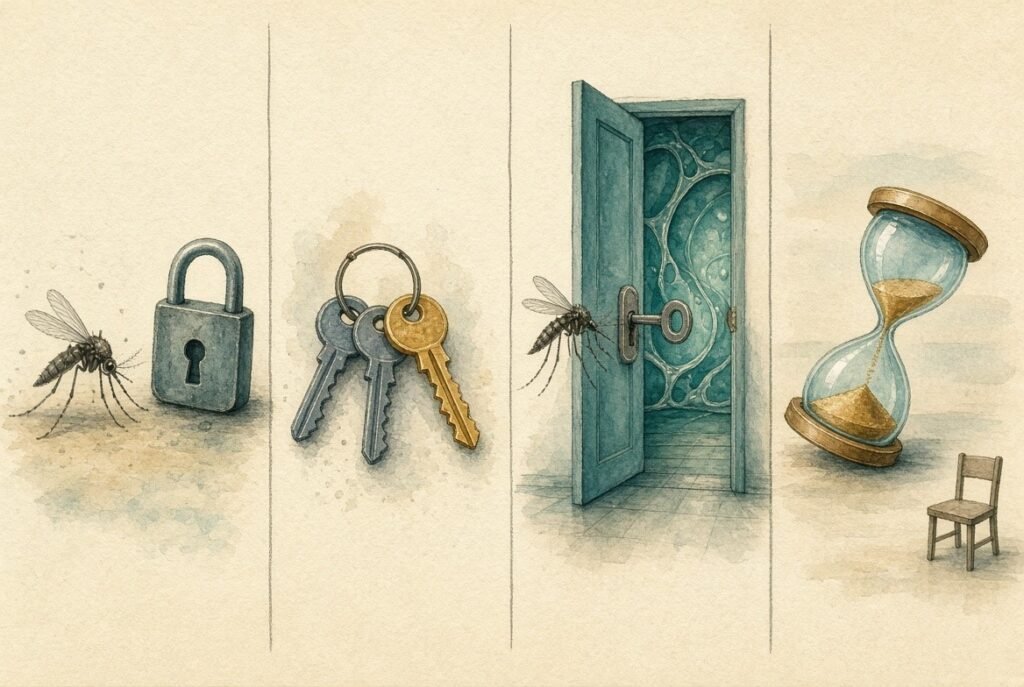
Picture four brothers. All of them are called dengue. One, two, three and four. Meet brother 1 and you usually get a fright and stay on your feet. The blood keeps a key to that door. Years later brother 3 arrives. The old key fits crooked. It does not lock. It pushes. The virus walks into the cell more easily than if the door had never been touched. It copies itself more. The person swells, bleeds, is admitted. Doctors call this ADE: the antibody that should defend helps the guest. It is not folklore. It is the classic way severe dengue appears — on the second infection, with another type.
A vaccine tries to hand over all four keys at once. The problem is the ring. None of the shots that reached the market leave the four equal. One shines. The others stay dull. Anyone who has never had dengue receives, in practice, a first artificial meeting with the type the vaccine holds well — and a slack meeting with the type it does not hold. If in three, five, ten years the mosquito brings the slack type, the body may sit in the dangerous window: too much antibody to ignore the virus, too little to kill it.
What has already happened
The first licensed dengue vaccine, Sanofi’s, taught this in children’s blood. Those who had never had dengue, after the third year, were hospitalised more often than those who got water. It ran in the New England Journal of Medicine in 2018. The Philippines paid the bill in wards. The label changed. A test first, or an age cut, or both. The mechanism the paper did not “prove” in a tube — ADE — was what the hospital showed in the corridor.
Takeda’s vaccine, the one Brazil is rolling into the queue, is another virus. A dengue-2 spine dressed in pieces of 1, 3 and 4. That is why 2 works. At three years, in children who had never had dengue, efficacy against type 3 was a negative number: minus 23 percent, a confidence interval that runs from “much worse” to “a little better.” Thirty-six cases in the vaccine arm, fifteen in placebo — the two-to-one draw. Hospitalised in that slice: eleven versus two. At four and a half years the company says: overall the shot still keeps people out of hospital. Against type 3 in the dengue-naïve, it did not show protection. Against type 4 there were almost no cases in the trial — so no one knows. Scott Halstead, who described ADE before many of the trialists were born, looked at the hospital line for type 3 in the naïve and read the echo of Sanofi. Takeda read chance and Sri Lanka, which admits almost everyone. Both men are reading the same row.
Why a trial on dengue street lies a little
A trial in a city where the mosquito already lives mixes three things: the shot, this week’s virus, and the virus the child caught without fever last year. Whoever already had a key uses the injection as a booster and the vaccine “works.” Whoever did not is the small group — precisely the group in which ADE, if it exists, will show. Placebo also gets infected all the time, so global efficacy looks handsome. If type 4 did not circulate, the vaccine earns a certificate the virus never marked. Being admitted in Sri Lanka is not the same as being admitted in the Philippines. A high titer in the lab the month after the second dose is not a locked door a decade later.
What no one puts on the paper the mother signs
ADE of severe dengue is a disease of time. The second natural infection may arrive in two years or in fifteen. The classic window is not “the next morning.” It is when the titer falls into the band where the key still catches and no longer locks. No one has followed a naïve vaccinee for twenty years. Sanofi showed the problem in year three. Takeda followed to about five and called the whole “no increase in severity” — with the type-3 hole in plain sight and type 4 invisible. SAGE and the label speak of children in endemic zones, sometimes without a blood test first. The consent form in the Brazilian queue does not say: if your child has never had dengue, this injection may imitate the first meeting; the dangerous meeting may be the next mosquito, in three years or in a generation; that study has not been born.
That is not the same as saying “the vaccine will kill in 2046.” It is to say that the risk severe dengue has always carried — the second brother — the vaccine may bring forward in those who were untouched, and that the campaign treats that risk as a footnote. Consent that hides the clock is not consent. It is a line.
Yellow fever, Zika, HIV — what crosses and what does not
Yellow fever and dengue are family. In the tube, antibody from the 17D shot can bind dengue and fail to neutralize it. On the Brazilian street, a study of eleven thousand dengue cases did not find yellow-fever vaccine making the illness worse. Zika does cross: dengue serum increases Zika in the lab, and the reverse has also been described. HIV is not a cousin of dengue. There is no HIV vaccine in the population. What exists is an HIV rapid test turning falsely positive in acute dengue — another wrong door, another kind of key. Mixing the three into one fear does not help the child in the queue. What helps is the simple question: has this child had dengue? Against which brother is this vaccine a real key? Anyone who answers “all four, just inject” is selling the ring as if it were four equal locks.
What fits on the bus
Severe dengue is almost always the second door. A vaccine that leaves three keys loose can be that first door. In people who already had dengue, the booster makes sense and Takeda’s large numbers live there. In people who never had it, type 2 is held and type 3 is left open — with hospitalisation that an honest reader does not call a win. Decades, no one measured. A mother has the right to hear that before the cotton wool. Science that is in a hurry for a queue and lazy about the clock is not science. It is a contract.
Meanwhile, following deaths allegedly linked to the vaccine, Brazil suspended vaccination with one of the manufacturers.
Isabel de Fátima Alvim Braga. MD phD.
Main sources
Classic ADE literature (Sangkawibha / Halstead) — severe dengue as second, heterologous infection.
Sridhar et al., N Engl J Med 2018 — Dengvaxia: extra hospitalisation in seronegatives.
Rivera et al., Clin Infect Dis 2022 — TAK-003 at 3 years: DENV-3 in seronegatives −23.4%; 36 vs 15 cases; 11 vs 2 hospitalised.
Tricou et al., Lancet Glob Health 2024 — TAK-003 at 4.5 years: no demonstrated efficacy against DENV-3/4 in the naïve.
Halstead, Lancet Glob Health 2024 — reading of the DENV-3 hospital imbalance in the naïve.
Katzelnick et al. — ADE tracks an intermediate titer band, not the absence of antibody.
Luppe et al. — yellow-fever vaccine and dengue severity in Brazil; no clinical worsening shown.

 Português do Brasil