

Isabel Braga
Synthesis with official sources and clinical trials · August 2026
Original: https://revistapahnorama.com.br/2026/08/30/hiv-no-brasil-mapa-prep-sifilis-sus/ · Faithful English translation. No facts added.
The premise the debate usually swaps
This text does not discuss whether someone is a man, a woman, homosexual, bisexual or heterosexual. Those words describe identity, affection and politics. HIV and Treponema pallidum read none of them. They find epithelium. They find anal mucosa — thin, little keratinised, rich in vessels, easily abraded in coitus — and vaginal and cervical mucosa, also vascularised, also exposed to micro-injury, also able to receive virus and bacterium. The epidemiological category “men who have sex with men” (MSM) is a statistical shortcut for practice, not a moral judgement and not an identity passport. Whoever declares heterosexual orientation and practises receptive or insertive anal sex with another man is, for the virus, in the same tissue. Whoever declares homosexual orientation and only has oral sex without ejaculation is at another risk. The sanitary map starts there: in the tissue, not in the name the person uses for themselves.
The Ministry of Health comes later. It buys the drug, writes the protocol, publishes the bulletin, negotiates a long-acting injection and authorises PrEP in the SUS from age 15. It does not determine the form the person fills in at the clinic, nor whether the partner of the pregnant woman with syphilis will be treated. Confusing the two layers — mucosa biology and federal management — is the most frequent error in the public debate.
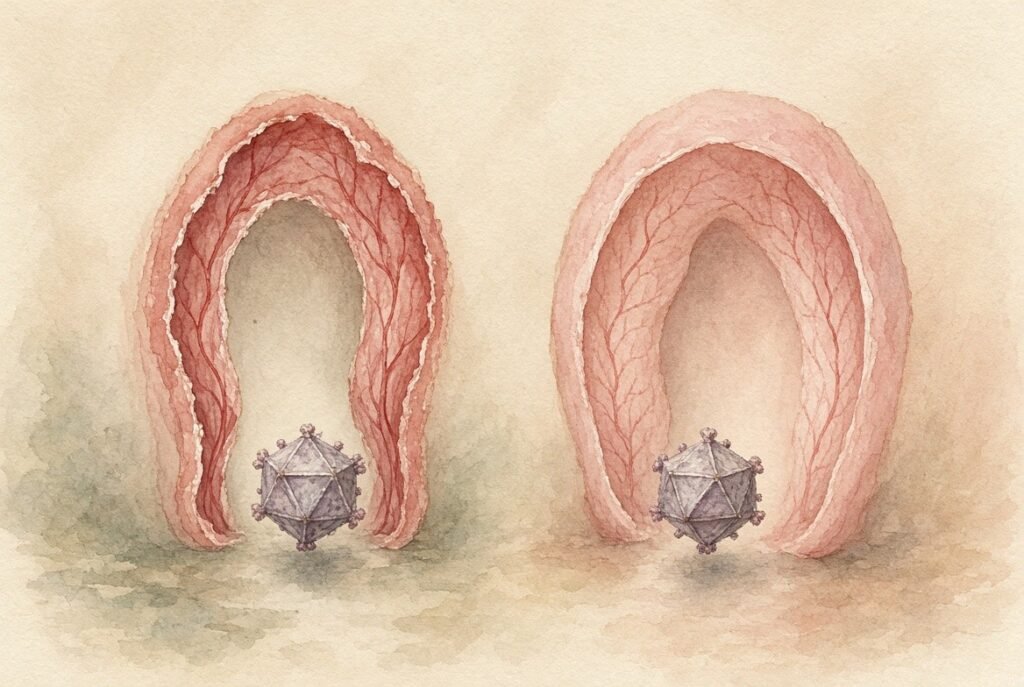
Figure 1 in the original: anal mucosa and vaginal/cervical mucosa as routes of exposure. Risk is tissue, load and abrasion — not an identity label.
Anal mucosa has a thinner epithelium and less mechanical barrier; anal intercourse, with or without adequate lubrication, produces micro-abrasions frequently. Vaginal mucosa and the cervical transformation zone also allow infection, with a longer oral-PrEP pharmacological window (about 21 days of daily use for estimated coverage, against about 7 days for anal sex). None of those sentences describes “being homosexual” or “being a woman.” They describe anatomy and pharmacokinetics.
What the Ministry bulletins show
HIV and AIDS: treatment rises; new infection does not fall at the same pace.
The 2025 HIV/AIDS Epidemiological Bulletin describes a country at two speeds. In 2024 there were 39,216 detections of HIV infection (18.4 per 100,000), against 38,222 in 2023 (18.1 per 100,000): stability with a slight rise. In the same year, AIDS cases receded 1.5% (36,955) and AIDS deaths fell 12.8% — from 10,500 to 9,157, the lowest standardised rate in the series (3.4 per 100,000). An estimated 1.1 million people live with HIV; 93% diagnosed, 81% of those diagnosed on therapy, 96% of these with suppressed viral load.[1]
That is treatment success, not primary-prevention success. Since 2007 the sex ratio in infection worsened: from 14 men for every 10 women to 27 to 10 in 2023. Young people aged 15 to 24 account for about a quarter of the historical stock; 25 to 34, about a third. In 2023, 53.6% of notified cases occurred in men with sexual practice with other men. In 2024, among men aged 13 or more with notified AIDS, the MSM category (37.3%) already surpassed the heterosexual classification (33.7%). In male adolescents aged 13 to 19 with AIDS, the MSM route reaches 59.8%.
Vertical HIV transmission went to the right place: rate below 2% and incidence in children below 0.5 per thousand live births, with antenatal, testing and treatment coverage of the pregnant woman above 95%. Pregnant women with HIV and exposed children fell in 2024. The ministry can claim that piece. The piece that does not fall is the young adult with exposed mucosa and a dense sexual network.
Unaids still places Brazil among Latin American countries with growth in new infections since 2010, concentrated in networks of anal sex among men. Prevalence in MSM under 25 had already jumped from 11.9% (2009) to 19.4% (2016) in surveillance surveys.[2]
The other map: the syphilis PrEP does not see
PrEP was not designed for Treponema pallidum. The 2025 Syphilis Bulletin is the obligatory counterpoint to any “combined prevention” balance sheet.[3]
| Indicator (2024) | Number | Rate |
| HIV detections | 39,216 | 18.4 / 100,000 |
| AIDS deaths | 9,157 | 3.4 / 100,000 (std.) |
| Acquired syphilis | 256,830 | 120.8 / 100,000 |
| Syphilis in pregnancy | 89,724 | 35.4 / 1,000 LB |
| Congenital syphilis | 24,443 | 9.6 / 1,000 LB |
| Infant deaths from syphilis | 183 | 7.2 / 100,000 LB |
Table 1. 2024 cut, Ministry of Health bulletins (HIV/AIDS 2025 and Syphilis 2025). LB = live births. WHO target for congenital syphilis: < 0.5 / 1,000 LB.
Men concentrate 61.3% of acquired syphilis. Rio de Janeiro reached 68.3 cases of gestational syphilis per thousand live births. In 27.2% of pregnant women notified with syphilis, the newborn was also notified. In the 2010–2024 series, only 17.7% of the mothers’ sexual partners were treated. Congenital syphilis receded a little in 2024; acquired syphilis did not.
That does not authorise the shortcut “PrEP caused syphilis.” It authorises the correct sentence: more detection, more sex without a mechanical barrier, and failure to treat the partner. Whoever trades the condom only for an anti-HIV tablet trades one virus for a bacterium that still kills infants. The mucosa that received HIV is the same that receives Treponema.
What the Ministry of Health actually holds on this map
Protocol, age and the Child and Adolescent Statute (ECA). The SUS offers TDF/FTC (tenofovir 300 mg + emtricitabine 200 mg) as daily PrEP or, in selected groups, on demand (2+1+1 schedule). The PCDT authorises it from age 15 and 35 kg, with a negative HIV test, renal function and quarterly follow-up.[4]
The legal logic the State itself uses is the ECA: the adolescent is a subject of the right to health (arts. 4, 7 and 11); HIV in adolescence is avoidable harm; refusing a tool to someone who already has a sex life and documented risk does not “protect childhood” — it only leaves the mucosa without an antidote. That does not cancel the duty to notify violence, exploitation or abuse (art. 13). Medicine does not replace a protection network. At 15, the correct question is not “may the adolescent have identity X.” It is: is there mucosal exposure with real risk? Is there testing, proportional confidentiality, a responsible adult when the law requires it, and continuity of care?[5]
Scale and cost of the oral drug. The PrEP dashboard and programme balances point to a base of the order of 110,000 users at the end of 2024 and expansion in 2025–2026 toward 140,000 to 230,000, depending on the cut (regular use versus at least one dispensation). Incremental cost of delivering PrEP in the SUS, in Salvador and São Paulo studies, sat between US$254 and US$321 per person-year (drug + service). Public purchase of the tablet is far below pharmacy price (about R$150 to R$230 for a 30-tablet bottle at retail). There is no isolated “PrEP-only” budget line in the ministry; the spend disappears into the HIV/STI block. A reasonable estimate for the recent management cut: R$200 to R$350 million a year on the oral product, if drug and basic follow-up are counted.[6]
Injectables and the table with industry. In January 2026 Anvisa included the PrEP indication of lenacapavir for adults and adolescents from 12 years and 35 kg. In 2026 the ministry announced an agreement to evaluate cabotegravir in the SUS and locked with Gilead on the price of lenacapavir. The public offer reported was of the order of US$400 per person-year — about ten times the generic negotiated for poor countries (US$40) and a fraction of the American price (US$25,000 to US$28,000). Gilead did not close. Brazil stayed outside the voluntary generic licences that cover 120 countries. That is a market and patent decision, not only a minister’s. But it is the ministry that sits at the table and that, if the price does not fall, leaves the six-monthly injection in the trial and in the private sector.[7]
The ministry, therefore, designs who enters, buys the oral product, tries the injectable and publishes the bulletin. It does not determine whether the user takes the tablet, whether the syphilis test becomes treatment of the couple, or whether whoever declares themselves straight on the form counts anal sex in the consulting room.
The label against the marketing
The emtricitabine + tenofovir label — including versions from a Brazilian public laboratory — is more sober than campaign speech. The product “is not always effective” in preventing HIV-1; efficacy “correlated strongly with adherence”; HIV-negative status must be confirmed immediately before starting; symptoms of acute infection require delay and retest. Creatinine clearance below 60 mL/min is out. There is a resistance risk if PrEP starts in acute infection still invisible to the rapid test. Estimated full effect: about 7 days for anal sex, 21 for vaginal, on daily use. Kidney and bone are the organs to watch. Oestrogen in a person using estradiol may reduce tenofovir in rectal mucosa.[8]
In the iPrEx trial, risk reduction in the whole set was 44%; with detectable drug in blood, it rose to the region of 90%. Later meta-analyses speak of about 54% in the set and about 73% with adherence above 70%. The phrase “99%” only holds in a scenario of almost perfect adherence.[9]
Lenacapavir, in the PURPOSE studies, came close to 100% efficacy in that design. Anvisa recorded, in the same act, the risk that matters for public policy: resistance if undiagnosed HIV meets the drug; injection-site reactions; residual concentrations for up to 12 months after the last dose; need for another PrEP if the person stops. Strong CYP3A inducers (rifampicin) drop the level. A six-monthly injection solves daily adherence; it does not solve late diagnosis or bacterial STI.[10]
Resistance, reservoir, the remission drug and the tablet that is missing
The campaign sells coverage. The label and the trials sell a condition. Four conditions weigh on the Brazilian map and almost never enter the poster.
Resistance. Oral PrEP with tenofovir + emtricitabine, if it starts in acute infection still invisible to the rapid test, or if use is irregular enough for the virus to replicate under incomplete pressure, selects classic mutations — above all M184V/I (emtricitabine) and, less often, K65R (tenofovir). Injectable cabotegravir, when infection occurs in the concentration tail, has already shown integrase mutations in trials and in implementation. Lenacapavir, a capsid inhibitor, also selects a capsid swap if undiagnosed HIV meets the drug alone. Resistance here is not an abstraction: it is a closed door in the treatment of whoever already lives with the virus.
The medicine that cure research also wants. Lenacapavir was not born as a prevention poster. It was born as a treatment piece for multidrug-resistant HIV and entered long-acting combinations — including with broadly neutralising antibodies — that the literature discusses as a path of remission, reservoir control and, at the optimistic limit, functionality close to cure. Reservoir is the HIV that sleeps in the cell genome and that the classic daily tablet does not erase. Burning that class in mass, as PrEP, without a diagnosis proof against acute infection and without a plan for whoever seroconverts, is using at the front door the key still reserved for the back room. It is not proven that lenacapavir alone empties the reservoir. It is documented that the same molecule is scarce, expensive, under patent, and that capsid resistance reduces what remains for the patient without other lines.
Absence of a long side-effect study. TDF/FTC has a kidney and bone series in adults; the series in a 15-year-old adolescent, with bone still closing, is shorter than the scale speech. Cabotegravir and lenacapavir carry injection-site reaction and, in the case of lenacapavir, residual concentration that Anvisa recorded for up to 12 months after the last dose — a window in which a pregnancy, tuberculosis treated with rifampicin or a stop without another PrEP have not been followed for decades. There is no Brazilian public ten-year cohort of lenacapavir in PrEP because the indication was registered in 2026. Absence of published long harm is not proof of long innocuity. It is a calendar.
Forgetting the tablet and acquiring the virus. The marketing phrase “99%” requires almost perfect adherence. In iPrEx the set fell to 44%; with detectable drug it rose to the region of 90%. Later meta-analyses: about 54% in the set and about 73% with adherence above 70%. Whoever delays TDF/FTC in anal sex loses coverage in days; in vaginal sex the window was already longer to build and faster to dismantle. Whoever delays the six-monthly injection enters the tail: virus enters, drug is still there, resistance learns. The ministry delivers the bottle. It does not swallow the tablet. The 2024 map — HIV detection stable or slightly up — fits this paragraph as much as it fits the sexual network.
None of those four sentences asks for the end of PrEP. It asks for the end of the poster that hides the label. Resistance, reservoir, bone, kidney, injection tail and the tablet in the drawer are sanitary management. They are exactly what the State reads when it stops reading only the commitment note.
Research and money: what the grants show
The ImPrEP family of trials — oral in Latin America (Brazil, Mexico, Peru), then long-acting cabotegravir and six-monthly lenacapavir in Brazil — is the main implementation programme of the new PrEP generation in the country. The declared target public is a person with risky anal-sex practice, including men with male partners and trans and non-binary people assigned male at birth, generally aged 16 to 30, in seven cities: São Paulo, Campinas, Rio de Janeiro, Nova Iguaçu, Salvador, Florianópolis and Manaus. The drug for the lenacapavir trial was donated by Gilead.[11]
The Unitaid line “Preparedness for Effective HIV Prevention among Key Affected Populations,” executed by a support foundation and Brazilian public institutes, sums, in board resolutions:[12]
| Unitaid resolution | Authorised value | Horizon |
| R7-2017-e | up to US$26,355,192 | Brazil, Mexico, Peru |
| R28-2021-e | + US$9,869,701 | to Dec. 2024 |
| R23-2024-e | + US$6,530,638 | to Dec. 2027 |
| Line total | ≈ US$42.8 million | 2017–2027 |
Table 2. Unitaid grants on the HIV-prevention preparedness line. Source: public Unitaid Board resolutions.
Unitaid also announced US$22 million to accelerate lenacapavir in Brazil and South Africa — the Brazilian slice not broken out in the announcement. There is also the PrEP1519 cut (ages 15 to 19, Salvador and São Paulo) in the same international-finance ecosystem.
That is multilateral implementation finance, not a parallel cashbox. It is also not an invisible budget: each extension passed a public resolution. The pertinent criticism is not the sum itself; it is whether the design (recruit whoever already seeks the service, 16 to 30, assumed risky anal sex on the form) reaches whoever practises the same act and declares themselves heterosexual — and the pregnant woman with syphilis, who are exactly the failures of the national map.
Practice without the name: the hole in the form
Again: MSM is an exposure category, not pride. The virus does not read orientation. It reads mucosa, viral load and how many links the network has.[13]
Brazilian surveillance has already seen the bias: part of the cases classified as “heterosexual” is self-declaration or the absence of a good question. Behaviour studies show the cut the ministry sees badly. In a sample of men with practice with other men in Fortaleza, 61.9% had already had intercourse with a woman. Ethnography in Rio described circuits of practice with men under the rule of not coming out as homosexual. Theses in the South interview married men, sometimes receptive in anal sex, who declare themselves heterosexual. An opinion survey (GQ/Ideia, 2022) found 11% of adult men as gay or bisexual and 82% straight — which, by definition, does not capture practice without identity.
The sanitary consequence is mechanical. The female partner enters the chain without knowing that the man’s risk is not only “another woman.” Congenital syphilis is the cruellest outcome of that omission: antenatal care tests the mother; the father-partner, in more than four in five cases in the long series, is not treated. A campaign that only speaks to whoever comes out as homosexual misses the link that still infects woman and newborn. A campaign that speaks only of “moral risk behaviour” misses the tissue. The useful sentence is prosaic: unprotected anal sex and unprotected vaginal sex, with a partner of unknown load, are mucosal events.
What the ministry must and must not
It must: publish the bulletin without makeup; buy the oral product at a state price; negotiate the injectable without signing an American cheque; require that a PrEP service test and treat syphilis, gonorrhoea and hepatitis at the same counter; not turn a 15-year-old adolescent into an informal guinea pig — and, if it includes them, require adequate consent, notification of risk when the law commands, and continuity of the drug after the study.
It must not be billed for an epidemiological miracle. Adherence is of whoever takes it. Secrecy of practice is of whoever does not name the act on the form. The price of a six-monthly capsid is of the patent. The ministry that reduces AIDS deaths and lives with acquired syphilis at 120.8 per 100,000 is winning the old war and drawing the new one.
Synthesis
The HIV map in Brazil, in 2026, is this: fewer coffins, the same young person, more bacterium. The Ministry of Health is in the middle — in the protocol, the purchase and the table with industry. Outside that perimeter, the virus and Treponema keep reading what the form does not write.
It is not about being a man, a woman, homosexual or straight. It is about anal mucosa and vaginal mucosa. The rest is language. Language matters for the consulting room and for the ECA. It does not matter to the viral envelope.
Method note
Notification numbers come from official Ministry of Health bulletins (HIV/AIDS 2025 and Syphilis 2025). Oral PrEP costs come from incremental-cost studies in the SUS and known public prices; the R$200–350 million/year band is a synthesis estimate, not an isolated line in the federal budget. Unitaid grants are values authorised in resolution, not necessarily disbursed year by year. Drug efficacy follows label and trials (iPrEx, PURPOSE). MSM categories describe practice, not identity.
References
[1] Ministry of Health. Boletim Epidemiológico HIV/Aids 2025. SVSA. Brasília, 2025.
[2] Unaids. Latin America regional reports and key-population surveillance. 2010–2025.
[3] Ministry of Health. Boletim Epidemiológico de Sífilis 2025. SVSA. Brasília, 2025. WHO congenital-syphilis elimination target < 0.5 / 1,000 live births.
[4] Ministry of Health. PCDT for HIV pre-exposure prophylaxis (PrEP). SUS offer from age 15 and 35 kg.
[5] Law 8.069/1990 (ECA), arts. 4, 7, 11 and 13.
[6] Incremental-cost studies of PrEP delivery in the SUS (Salvador and São Paulo): US$254–321 per person-year.
[7] Anvisa. Lenacapavir PrEP indication, January 2026. Ministry of Health. Cabotegravir evaluation and Gilead price negotiation, 2026.
[8] Emtricitabine 200 mg + tenofovir disoproxil 300 mg label (TDF/FTC), Anvisa-registered public and private laboratories.
[9] Grant RM et al. iPrEx. N Engl J Med. 2010;363:2587-2599. Later adherence meta-analyses.
[10] PURPOSE studies (lenacapavir for PrEP) and Anvisa product registration, 2026.
[11] ImPrEP protocols (oral Latin America; cabotegravir and lenacapavir in Brazil). Declared recruitment: 16–30 years, documented-risk anal sex, seven Brazilian cities.
[12] Unitaid Board resolutions R7-2017-e, R28-2021-e and R23-2024-e. Additional announcement of lenacapavir support in Brazil and South Africa.
[13] Behaviour studies in Fortaleza and southern Brazil; ethnographies of practice circuits without corresponding identity in Rio de Janeiro; self-declared orientation surveys (GQ/Ideia, 2022).

 Português do Brasil