

On 28 April 2026 I walked into a hearing room of the Brazilian Senate with a slide deck and the medical-expertise files of the house that employs me. The bill on the table, PL 2.745/2021, authored by Senator Jorge Kajuru of Goiás, wanted “false information about vaccines” written into the Penal Code. I spoke as a tenured public servant, not as the voice of the Oswaldo Cruz Foundation — Fiocruz, the federal institute that fills the Oxford–AstraZeneca shot at Bio-Manguinhos and that, twenty-six days later, would take me to court.

What I put on the screen that morning was not a blog. It was the government’s own sick-leave and disability files, and the national registry of births; live births and congenital-anomaly counts for the two states driving the bill, 2014–2024; twelve cases of herpes zoster among nurses at the Foundation’s own children’s hospital in the fifth week after a trial; a primate colony that had already shed human tuberculosis and was still booked as a vaccine model; tax-exemption files in which neoplasms had risen more than fivefold. I said a temporal overlay is not a verdict of causation. I said it in the room.

Less than a month later the Foundation, through the Union’s own lawyers asked a federal judge in Rio to order Meta to delete my profiles, bar new ones, and keep me from using the image of the Castelo Mourisco, the same building on the first slide. UOL, G1, O Globo and Veja used one word: disinformation. Gazeta do Povo used another: prior restraint. The Foundation was asked for comment. It did not answer.
If you do not live in Brazil, the rest of the names are simple. Fiocruz sits under the Ministry of Health. Fiotec is the private foundation that pays its projects and, in 2021, was asked to buy a R$ 750,000 cupboard for the secret pages of the AstraZeneca contracts. Secom is the Presidency’s advertising office. A technological-order contract is simply a purchase that also promises know-how. The raw ingredient of a vaccine is what the factory starts with before the vial is filled. The rare clot-and-low-platelet syndrome after some viral-vector shots is diagnosed with a blood test for an antibody called anti-PF4 the public system did not stock when a 28-year-old lawyer in Blumenau needed it. The injunction binds speech inside Brazil. It does not bind this text. Every number below has a source. None of them, standing alone, closes a verdict.
I am Isabel de Fátima Alvim Braga. I am a doctor of public health and environment. I had fifteen years in the service before the first administrative file. Then three administrative proceedings and two lawsuits in a single month, all from the same house.
“There is no silence that does not end.”
When the physician formally reported to the Federal Police that the Fiocruz chief federal attorney had leaked her confidential disciplinary file to the institution’s press office, the answer from the top of the same career was not investigation but closure. The record in Despacho n.º 00060/2026 and the e-mail to CCS head Raquel Aguiar, copied to another prosecutor on the case, shows the sealed PAD and litigation strategy leaving the legal unit and entering the communications shop before she was even formally notified. She took that leak to the PF on 15 August 2026 (arts. 319, 321 and 325 of the Criminal Code). Weeks later, Opinion n. 15/2026/CHGAB/PGF/AGU — approved by Deputy Attorney General Igor Lins da Rocha Lourenço with the line “I agree. Proceed as suggested” — asked the Federal Prosecution Service, the Federal Police, the CGU and the Ethics Commission to archive the very complaints that documented the leak, and asked the civil court to treat her filings as “coercion.” That is the second lock on the door: first the confidential file is handed to the press apparatus; then the office that should supervise the attorney who handed it over tries to bury the police paper that named the handoff. The denunciation of the leak is recast as an attack on the career; the leak itself is left unexamined. Silencing here is not a metaphor. It is a written request, signed at the deputy-attorney-general level, that the external files be shut.
What I put on the screen
The sources on the slides were not a blog. They were the medical-expertise files of Fiocruz — leaves and income-tax exemptions — the government’s sick-leave files and the national birth registry. I thanked, on the slide, Dr. Caio Salvino and Dr. Manuela Emiliana Amorelli Chacel. I chose Goiás and Mato Grosso do Sul because those are the states of the senators driving the bill.
What the tables showed, as I calculated them from live births and congenital-anomaly counts, 2014–2024, rate per 10,000 live births:

Goiás: 2.71 (2014) → 8.39 (2023) → 7.88 (2024). Mato Grosso do Sul: 0.68 (2014) → 4.22 (2024), with a jump already visible in 2016.

Live births fell in both states over the same decade — Goiás from 99,789 to 88,867; Mato Grosso do Sul from 44,058 to 37,908.

Inside the Fundação’s own expertise service I reported, as an occupational physician reading files, not as a trial statistician: obstetric leaves down by more than half; the share of miscarriages among recorded outcomes up; income-tax exemptions for Parkinson more than threefold; exemptions for neoplasms more than fivefold, with breast, colon and prostate named on the slide; a pattern of short leave and fast death that I described as accelerated against the usual course.

October 2020 is not a random month. On 26–30 October the Fundação sent the Chamber the technological-order contract with AstraZeneca and published it on its own portal — 100.4 million doses, fill-and-finish at Bio-Manguinhos, the Brazil arm of the Oxford phase 3 already running (4,088 Brazilians in the Lancet interim, data cut 4 November 2020). The federal audit court’s own follow-up of Ministry contracts listed, among Fiocruz’s largest 2020 commitments, AstraZeneca UK Limited at R$ 1,284,023,632.94. The purchase-contract clause the auditors transcribed put the consideration at US$ 188 million net — US$ 163 million for the active ingredient, US$ 25 million for pre-existing scale-up knowledge — taxes on the Brazilian side, total around US$ 250.7 million. a 2020 emergency decree opened about R$ 1.9 billion for the order. A second instrument, the contract that was supposed to let Brazil make the raw ingredient at home, was signed on 1 June 2021. Intellectual property stayed with the foreign holder. The country assembled the box. Those annexes did not arrive in this civil file on the date the rules required. The dye file did. The published safety table listed 175 serious adverse events in 168 people. It did not list the cancer rise I later read in the same house’s tax-exemption files. Those neoplasms are not in the trial register as site cancers. That is the point I took to the Senate: the event existed in the expertise folder and did not exist in the paper.
I also recorded twelve cases of herpes zoster among nurses at the the Foundation’s children’s hospital in the fifth week after a trial, inside sixty days — events I said the investigators did not notify. A cluster on a paediatric campus is an occupational fact. It is not a line in the protocol’s “solicited adverse events.” I put perioperative thrombosis, infection and failed healing at more than ten times the 1–5% baseline I cited. I put a slide on sleep, the chemistry of sleep and inflammation. I put a slide on animal work: tuberculosis in primates, mycoplasma in rodents.

The animals were not a footnote. They were a colony carrying the human bacillus, dying for years, and still booked as a vaccine model. The public case file — no. 5035958-79.2026.4.02.5101, 20th Federal Court of Rio — already joined the years. Outbreak of the human tuberculosis germ in the rhesus colony in 2011–2012, with “death of a large number of animals.” A laboratory without the tool to test spit for the germ. A serological kit described in the meeting as unfit for routine use.

A container without biosafety level for the sick animal. A former staff member who started tuberculosis treatment and stopped because he “had improved.” In October 2020 a testicular granuloma, lab tests positive for the human bacillus. In the holding colony, 34 positive or suspect in 431 — 8 percent. Declared control: euthanasia of the positive, the suspect and group contacts, including a pregnant female. Head count of the order of 550 in 2012, 484 in 2023, in a colony that had already passed 950. European and American animal-lab rules all say the skin test lies and that you test on arrival and again. A colony that sheds human tuberculosis does not give a clean vaccine number. It gives bias. That is what the Senate slide named in one line. Planet of the Apes named the file.
I put the national health-card app that broke the trial’s blinding, the extra doses, the Nuremberg file, the manufacturers’ missing reports.

A temporal overlay is not a verdict of causation. I said so in the room. The Fundação’s lawyers told the judge it was a campaign. The judge, on a preliminary reading, agreed with them. The data did not disappear because a profile was taken down.
Uranium: what was on the site, what the well measured, what the court forbade
The Fundação’s own campus includes the campus quality-control institute. A 2019 doctoral thesis there reported high uranium in samples from the São João basin, read by a standard laboratory method. I protocolled the Biology Council in January 2025 asking for an inquiry into titration of uranium without proper radiological containment. The slides in Brasília named contamination at that institute and the vaccination of staff on the same campus.

What the fact-checkers ran in February 2026 was a different sentence: that I had said uranyl acetate in a routine electron-microscopy stain had poisoned the tap water of Rio. ANSN and Fiocruz answered that the reagent is used in milligrams, worldwide, and that the natural uranium load of rivers exceeds the inventory of city labs. UOL Confere headlined the denial. I do not need their headline. I need the other number, which is not mine: José Marcus Godoy and PUC-Rio, Journal of the Brazilian Chemical Society, 2019 — groundwater in the Serra, wells below eighty metres, uranium up to 930 micrograms per litre against a drinking-water limit of 30. Thirty times. Seven of sixteen mountain municipalities. That paper is in the open literature. Pàhnorama has already written the distinction: the well is not Copacabana; the stain is not the ore; the thesis is not a press release.
The court listed the uranium posts among the publications to be erased.
The house never sat down in public and answered the complaint I actually wrote. Gazeta do Povo asked the Fundação for comment after the injunction. Silence. What it did open was a disciplinary file and a lawsuit. The public version of my alert was reduced to uranyl acetate — a microscopy stain, a dye, milligrams in a hood. The protocol I sent the Biology Council in January 2025 was not about a dye. It was uranium without radiological containment, powder and titration at the quality-control institute, and a campus that still advertises a national anthrax laboratory. Dye is the word that fits a press kit. Powder and Bacillus anthracis are the words that were on the page and in the official letter. The administration chose the dye. It did not choose a public hearing.
Anthrax: it was on the institutional page
The Instituto Oswaldo Cruz still describes, in public, a national reference laboratory for anthrax — anthrax. National reference for the Ministry of Health. Diagnosis of Bacillus anthracis in human and veterinary material. Assays on suspected intentional preparations. Soil. Animal products. genetic tests that identify the bacterium. The laboratory was stood up after 2001. The Ministry of Health itself circulated, as a public document, the extra U.S. advisory recommendations on anthrax vaccine in a terrorism response.

Brazil did not put anthrax on the child’s card at the health post. It kept the organism in a reference laboratory on a campus that also makes vaccines. That is not a rumour from a channel. That is the Fundação’s own service list.
Who pays the newsroom that called me a liar
On 1 September 2026 this magazine published the ledgers: “Quem paga a conta da imprensa no Brasil?” The rule of that dossier is the same as this one: a number enters only with a payer, a payee and a public source.
Secom — the Presidency’s communications office — spent R$ 954.5 million on official advertising from January 2023 to June 2026 (R$ 175.9 million in 2023; R$ 234.9 million in 2024; R$ 365.7 million in 2025; R$ 178 million to 15 June 2026). Grupo Globo took R$ 267.1 million — 25.6 percent. Grupo Record R$ 122.6 million. Meta / Facebook R$ 85.9 million. Google Brasil R$ 80.9 million. SBT / SBT News R$ 68.7 million. Then Bandeirantes R$ 49.8 million, Kwai R$ 26.3 million, TikTok R$ 13.6 million, RedeTV! R$ 11.3 million, Folha / UOL R$ 9.4 million, X R$ 6.9 million. In the first half of 2026 alone, to 15 June: Globo R$ 33 million, Google R$ 23 million, Meta R$ 18.6 million, Record R$ 13.4 million.
That is one tap. State-owned companies keep their own advertising books, not all of them inside Secom: Petrobras on the order of R$ 474 million; Banco do Brasil on the order of R$ 750 million in the dossier’s cut (R$ 595.2 million cited for 2024); Caixa on the order of R$ 468 million (R$ 361.6 million January–November 2024). EBC, the public broadcaster, took R$ 452.95 million from the Union in the Transparency cut the article used; its 2026 draft budget line was R$ 1.164 billion; a Secom content contract in 2024 was R$ 60.0 million.
A third tap is payroll-tax relief. payroll-tax relief for the communications sector, January–August 2024: R$ 462.13 million. Globo Comunicação e Participações S/A (tax ID 27.865.757/0001-02) alone: R$ 150.04 million in that window; Editora Globo another R$ 19.26 million; the Globo group about R$ 173.3 million — 35.74 percent of the media-sector relief in that cut. TV Record São Paulo R$ 29.97 million. SBT Canal 4 São Paulo R$ 17.58 million. UOL–Folha group R$ 39.3 million. Grupo Estado R$ 16 million.
A fourth tap is tax expenditure stocked on the Transparency Portal (IRPJ and mixed years, including the deduction that compensates free electoral airtime under Laws 9.096/1995 and 9.504/1997). Globo Comunicação e Participações: R$ 4,335,172,405.47 as a stock of years added together — 2023 R$ 336.29 million, 2022 R$ 866.67 million, 2020 R$ 448.72 million, among others. That stock is not Secom and is not an amendment. Without it, Globo looks like “only” R$ 267 million of official ads. With it the holding’s card is in the billions of reais the Treasury did not collect. Free electoral time itself was costed by Estadão, August 2026, at about R$ 996 million in one cycle, recovered as an IRPJ deduction. Parliamentary amendments to the Globo companies in that dossier were small: R$ 7,829.80 to the holding, R$ 13,573.39 to Editora Globo.
The money goes into a company tax number — not into a reporter’s pocket. Then the same mastheads write “fake news” over a civil servant who used government sick-leave files and the national birth registry in a Senate annex. Advertising does not prove a reporter invented a headline. It proves the State is a client of the newsroom that then described the injunction as hygiene.

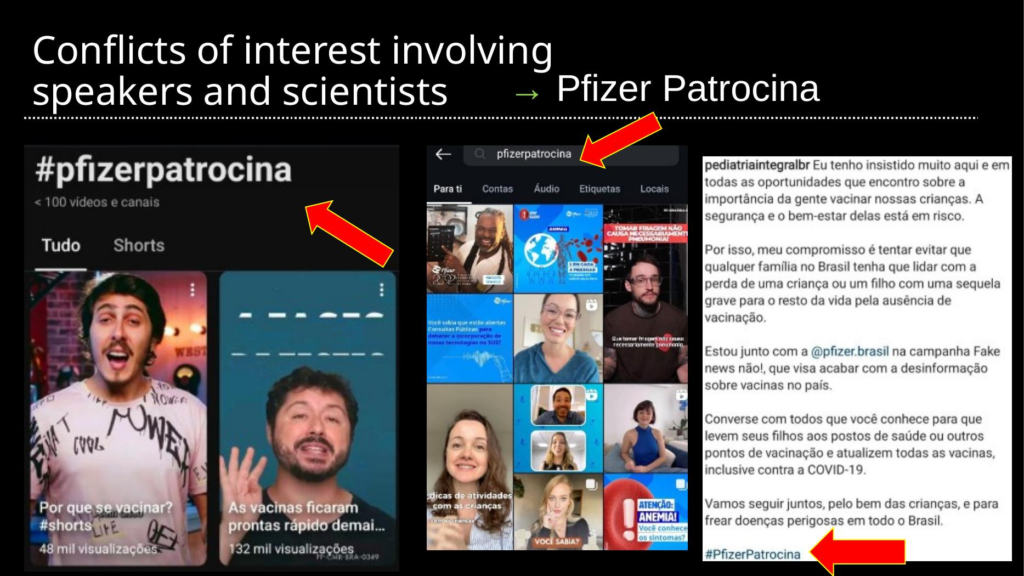
The last slides of the deck I took to the CAS were conflicts: the Paraná molecular-biology institute (R$2 billions?) betting houses and NGOs on the same programme, a banner that read Pfizer Patrocina. I did not invent the banner. I photographed the room.
Where the money went
The same question, asked of the emergency itself, is in another text I signed at Médicos pela Vida: “Emendas, créditos e vacinas: para onde foi o dinheiro do enfrentamento da Covid-19?” The society has the right to know how much was allocated, by whom, to whom, and with what concrete result. The federal audit court’s own cut of extraordinary credits showed parliamentary amendments cancelled to open Covid lines in amounts above R$ 5.8 billion. a 2020 emergency decree sent R$ 204 million to EBSERH and R$ 57 million to the Hospital de Clínicas de Porto Alegre. The UFRJ hospital complex took R$ 43.4 million. More than R$ 37 million in redirected amendments went unused or returned in 2020. Between 2020 and August 2024, transfers to civil-society organisations ran to about R$ 5.7 billion — R$ 3.55 billion in individual amendments (individual amendments), R$ 1.27 billion in rapporteur amendments (rapporteur amendments). Health amendments to Santas Casas, 2019–2024, about R$ 2 billion; to Fundação Pio XII / Hospital de Amor, about R$ 1 billion.
The vaccine contracts were the other tap. Butantan–Sinovac, CoronaVac: on the order of 46 million doses in an early agreement; public figures for federal purchases in the range of R$ 2.5 billion to R$ 3.1 billion across stages. Intellectual property stayed with Sinovac; commercial use by Butantan needed a separate licence. In 2023 another CoronaVac contract of about R$ 330 million — the audit court later pointed to hundreds of millions lost to late contracting and short shelf life, with far fewer doses actually used than bought. What was sold as “technology transfer” was, in the language of that article, fill-and-finish: the country received ready or semi-finished active ingredient and assembled the box. Know-how and the patent stayed abroad. Anvisa shortened review to days. Billions were committed while the know-how remained partial. The article itself says the exact slice that was “Covid only” is still hard to isolate. That is not a slogan. It is the control agencies’ diagnosis.
The Secom million and the extraordinary billion are not the same ledger. They are the same country: public money into the product, public money into the masthead that then called the ledger fake news.
Fiotec: the private pipe next to the castle
Fiotec — Fundação para o Desenvolvimento Científico e Tecnológico em Saúde, tax ID 02.385.669/0001-74 — is a private support foundation under the 1994 law that lets federal labs hire a private support foundation. It is not the Fundação Oswaldo Cruz. It buys, pays scholarships, holds international grants and, in August 2021, was the desk that received the request for the R$ 750,000 classified cupboard. The federal Transparency Portal records more than R$ 11 billion in Fiotec’s historical relation with the Union. On amendments alone the same portal lists 528 parliamentary amendments and about R$ 874 million paid. Those two figures are different cuts. They must not be added.
Fiotec’s own amendments portal, compiled in this magazine on 10 September 2026, shows committed amounts: 2020 R$ 4,363,846.92; 2021 R$ 6,113,300.00; 2022 R$ 1,621,989.00; 2023 R$ 15,347,057.33; 2024 R$ 35,078,384.32; 2025 R$ 22,729,419.40. Sum 2020–2025: R$ 85,253,996.97. That is the house’s own window, not the historical R$ 874 million. In the recent cut a single 2025 commitment in the name of Deputy Dimas Gadelha is R$ 11,485,622.21. Deputy Henrique Vieira appears in the same list in the millions. When public money leaves the Union budget and enters a private foundation, the path gets longer. Concentration demands more transparency, not less. the 2024 federal audit of public works had already said the vaccine-export accounts at Fiotec were not in the open.
HIV, Unitaid, UNAIDS — and the same desk
The ImPrEP line — oral PrEP, then injectable cabotegravir, then six-month lenacapavir — is coordinated at Fiocruz’s Instituto Nacional de Infectologia with financial management at Fiotec and money from Unitaid. Unitaid’s own board papers, as compiled in the same 10 September dossier: lead grantee Fiocruz, announced envelope about US$ 42.8 million for 2017–2027. Initial authorisation up to US$ 26,355,192 (2017); add-on up to US$ 9,869,701 (2021); cost extension up to US$ 6,530,638 through 31 December 2027, implementer Fiotec (Resolution 23-2024-e). The 2017 launch was announced at about US$ 20 million for Brazil, Mexico and Peru; UNAIDS Brazil sat at that table and called PrEP a global recommendation. I have not found a separate UNAIDS cash grant with a public dollar line equal to the Unitaid envelope. What is documented is the agency in the room and Unitaid in the ledger.
ImPrEP CAB Brasil added on the order of US$ 10 million. ImPrEP LEN Brasil puts six-month lenacapavir, donated by Gilead, in seven cities — Rio, Nova Iguaçu, São Paulo, Campinas, Salvador, Florianópolis, Manaus — about 1,500 participants. Unitaid in late 2024 announced a further US$ 22 million globally to speed lenacapavir as long-acting PrEP, starting with Fiocruz and Wits RHI. In January 2026 Gilead and Farmanguinhos signed a memorandum on a possible future technology transfer for the same molecule. In July 2026 Fiocruz and MSD signed another memorandum on monthly alimatravir (MK-8527), still in phase 3. Brazil was left out of the voluntary generic licence that would have brought the US$ 40-a-year price Unitaid celebrated for other countries.
CDC/PEPFAR and industry partnerships in Brazilian HIV are larger than these grants. The journalistic point is narrower: international dollars, parliamentary amendments and internal fellowships pass, in part, through the same private foundation that was asked to build the secret cupboard for the AstraZeneca contracts. There is no single public dashboard that draws that map.
Who paid the microphone
Pàhnorama, 14 September 2026: “Quem paga o microfone da vacina no Brasil.” The rule of that dossier is the same as this one — a number, a logo or a Diário Oficial, or it does not enter. Instituto Lado a Lado pela Vida, Marlene Oliveira, Novembro Azul, later HPV. On the institutional slide headed “Nossos apoiadores financeiros” the mosaic is AstraZeneca, Bayer, Bristol Myers Squibb, Gillette, GSK, MSD, Novartis, Pfizer, Roche, SENAR — and Casa Apostas. The only outfit in that list that printed a betting house among its financial supporters. The paper did not see the contract or the real. It saw the logo. Pharma next to a bet, on a health NGO’s own capture. In Brazil a bet buys a football shirt. This one bought a place beside Pfizer.

The influencers were not living on a pensioner’s pix. Instituto Serrapilheira’s own card for Átila Iamarino lists Grant 2020 R$ 300,000; add-on 2020 R$ 60,000; Grant 2022 R$ 300,000; Grant 2023 R$ 300,000; Grant 2024 R$ 150,000. Published sum: R$ 1,110,000. The institute’s Covid page says the 2020 emergency support ran YouTube, Twitter, Instagram and Telegram; 14 April to 10 July that year, 18.8 million views under that support. Later the money was renegotiated toward Instituto Não Ficção. That does not prove a lie for hire. It proves the loudest Covid microphone on Brazilian YouTube was not AdSense alone.
Natalia Pasternak and Carlos Orsi’s Instituto Questão de Ciência sat on the same Serrapilheira pipe for VacinaBR with the Sociedade Brasileira de Imunizações. Unidos Pela Vacina, Luiza Helena Trajano’s Mulheres do Brasil, was launched with corporate names the press put in the R$ 50–60 million range of donated kit. Luana Araújo went on the Lado a Lado cast to talk immunisation. The Senate slide I carried already had the Paraná molecular-biology institute, betting houses and NGOs on the same programme, and a banner that read Pfizer Patrocina. I photographed the room. The 14 September dossier photographed the mosaic. Same country. Same microphone. Different receipt.
The plant that never rose
August 2022: Fiocruz signed with the NCPFI-RJ consortium a built-to-suit for the Complexo Industrial de Biotecnologia em Saúde — CIBS — in Santa Cruz, Rio, tied to Bio-Manguinhos. The federal audit court’s own figure for the contract was about R$ 9.73 billion. Minister Benjamin Zymler, reporting the file, spoke of CAPEX around R$ 9 billion. Extra, in April 2025, walked the lot: sixteen years from the first studies, some R$ 1.2 billion already spent in earlier phases, and the ground still scrub. The auditors wrote that there was no contractual execution because the consortium could not raise the private money. In October 2025 the audit court approved a consensual unwind: the contract ends, Fiocruz keeps the technical studies, the consortium takes an adjustment on the order of R$ 16.5 million. the 2024 federal audit of public works had already flagged Fiotec’s missing accounts on vaccine-export revenue. A plant sold as sovereignty. A field that did not go up.
Lymphopenia, Nature, and the tooth
The manufacturer’s own early trial of the Oxford shot that Bio-Manguinhos filled recorded a short drop in a kind of white cell — neutrophils — in 46 percent of recipients. The later official product sheet listed swollen lymph nodes and added low platelets. A 2024 case in the Journal of Allergy and Clinical Immunology: Global described a drop in the T-cells that steer the immune system, after the AstraZeneca shot. That is the label and the literature.
Nature’s family of journals has already collected what happens in the mouth after these products: Evidence-Based Dentistry, 2024, a systematic review of oral adverse events post-COVID vaccination — immune-mediated lesions. A Norwegian survey put gingival bleeding higher after an adenovirus-vectored shot than after mRNA. One cross-section found more periodontal symptoms, including mobility and tooth loss, reported after Oxford-AstraZeneca than after other brands — the authors themselves said the design cannot prove cause.
The chain that is possible, and that I will not dress as a verdict: a drop in the white cells that keep the gums and the rest of the body from being overrun is a drop in the cells that keep a periodontal pocket from becoming a lost tooth. The manufacturer tabulated the drop. Nature tabulated the mouth. The expertise files I read tabulated the rest. Three columns. Not one paper that closes the three. The possibility is not mysticism. It is the same immune system the insert already named.

Arroio Grande
The last risk slide before Obrigada was not a laboratory. Two children, one and four, removed from their parents in Arroio Grande, Rio Grande do Sul, after medical certificates contraindicating vaccines and a filmed consultation the court would not allow. The town hall said no child is sheltered “for isolated reasons such as vaccination.” The parents have another story. The file is in the juvenile court. A state that will take a breastfed infant over a card is a state that has already decided which silence it prefers.
The children’s hospital and the Zoom
The same IFF — the Foundation’s children’s hospital, the Fundação’s hospital for women, children and adolescents — is in the tréplica filed in case 5035958-79.2026.4.02.5101. Not as rumour. As the protocol the Autora herself joined to the file.
The study is titled “Crianças e adolescentes com experiências trans: violência, subjetividade e práticas de cuidado” (CAETS). Coordinator named in the project: Paula Gaudenzi. Unit director named: Antônio Flávio Vitarelli Meirelles.
The protocol sets the interview age at six years to seventeen years and eleven months. It suggests that parents not sit in the interview unless child and parents both agree. After the pandemic, it says, interviews will be done on video platforms — Zoom first, WhatsApp, Google Meet or Skype allowed — and recorded. On 12 November 2025 the project’s Instagram, @pesquisa.caets, posted a public call: adolescents 14 to 17 from named low-income communities, a R$ 700 stipend, “hours to be arranged with the coordination,” to take part in an audiovisual documentary. The project document, three years, lists a documentary of about thirty minutes, made with the adolescents, for schools, squares, public health services and the Public Defender’s Office. It also lists “action-research.” The budget lines in the same paper: Period 1 R$ 147,200; Period 2 R$ 182,800, of which R$ 140,000 for an audiovisual firm; Period 3 R$ 20,000 — more than R$ 350,000, public money, Fiocruz/IFF. I took the figure to the federal audit court on 20 June 2026 as nearly R$ 400,000 for filming children in that setting. I asked, in the pleading, how “mere Zoom meetings” cost that.
The ethics section of the project itself admits risk to name and image and risk of psychic suffering. It floats animation or fictional characters. It keeps the documentary with the adolescents. It also says there will be no use of patients’ image or voice in public exhibitions — next to a product designed for wide public showing. the 2022 medical-board rule on health platforms wants health platforms with audit trails, not a generic conference app. the child-protection statute, including its 2025 digital update want specific consent and, for public artistic use of a child’s image, a court licence. The recruitment post did not set those out in a structured way.
I filed the medical board, the audit court, an official letter on 3 July 2026, and the federal prosecutors on 16 August. No public answer from the administration. The house that sued me for speaking about a vaccine sued me, in the same breath, over this hospital. – https://www.instagram.com/pesquisa.caets/
What the Gazeta wrote — and the date the papers never came
Gazeta do Povo did not invent a slogan. On 20 May 2026 Leonardo Desideri wrote the word the Constitution already had: prior restraint. The order did not only take posts down. It forbade new accounts. A lawyer told the paper that is censorship before speech exists. On 31 May the same paper ran the interview: fifteen years without a file, then three administrative proceedings and two lawsuits in one month. The Fundação was asked for comment. It did not answer. On 14 June the editorial board put the case next to the dengue-vaccine pause and called the climate what it was: a gag that treats a technical question as an enemy of the people. Luciano Trigo, two days after the interview, reached for Ibsen. An enemy of the people is the physician who brings a table the town does not want read.
The paper named the veto on speech. It could not name the missing exhibit, because the exhibit was never filed on time.
Why did the Brazilian government — the Fundação, the Union’s lawyers, the State that occupies both poles — never present the documents on the correct date?
The AstraZeneca purchase contract and the raw-ingredient transfer of 1 June 2021 — the instruments that moved more than a billion reais toward the same campus that later sued the examiner who read those sick-leave files. The 2024 federal audit of public works had already said Fiotec’s vaccine-export accounts were not in the open. CNN Brasil, 31 August 2021: the Fundação asked Fiotec to build a place to keep the secret pages of the AstraZeneca contracts. An imported safe at R$ 130,000. A structure budgeted at R$ 750,000 — the armário in the open press. Classification: secret, locked for up to fifteen years, which means 2036 at the earliest. Two instruments into that box: the September 2020 purchase contract and the raw-ingredient transfer. Also in the request: tape to mark the room, foreign travel “for the handling of classified information,” two staff on regular labour contracts for two years. The house that sued me for a video spent three-quarters of a million to put the contracts in a cupboard. I asked for the annexes on the date the civil file required them. The answer was a safe. The radiological inventory and the waste manifest the CNEN would have to hold. The full ethics-board file for the children’s study, not the Instagram card. The sick-leave extracts behind the Senate slides. The papers for a R$ 9.73 billion vaccine plant that is still a field. The manufacturer’s 46 percent white-cell drop next to the expertise folder. The dye file arrived in time to get a preliminary injunction. The other file did not arrive at all. A State that can find a judge in days and cannot find a licence, a ledger or a consent form on the day the rules of the case require it is not short of paper. It is choosing which paper counts.
Bruno Graf and the test the SUS did not have
On 14 August 2021 Bruno Oscar Graf, a 28-year-old lawyer in Blumenau, took the first dose of AstraZeneca at Parque Vila Germânica. Twelve days later he was dead. The immediate cause was a haemorrhagic stroke. The test that names the syndrome is anti-PF4, a blood test done on plasma. The family’s authorised report: positive. Laboratory cut-off: a laboratory reading above the cut-off of 0.4. It is not an allergy test. It is the antibody that defines vaccine-induced thrombotic thrombocytopenia, the same clot-and-low-platelet syndrome Greinacher and Schultz described in the New England Journal in 2021.

On 20 August 2021 — six days after his dose, six days before his death — the Ministry of Health published a Ministry technical note in August 2021. It named the ELISA. It said draw the right tube and send it to the reference blood centre. It said treat without waiting: immune globulin into the vein, a blood thinner that is not heparin. It also said the gold-standard test was not on the public-system menu. The mother paid. Santa Catarina’s DIVE bulletin later wrote thrombosis of the central nervous system with thrombocytopenia, temporally associated with AstraZeneca, confirmed as STT. Without the ELISA the death certificate is a stroke. With it the certificate has a name the insert already carried.
The same product Bio-Manguinhos filled. The same campus that later asked a judge to close a physician’s mouth.
The births that did not come
On 6 September 2026 I published the national live-birth line in this magazine: “Os nascimentos caíram. A prematuridade voltou ao pico. Em 27 estados.” Babies born alive, Brazil: 2.945 million in 2018, 2.677 million in 2021, 2.389 million in 2024. A fall of 18.9 percent from 2018 to 2024. Rate per 100,000 inhabitants: about 1,476 in 2015, about 1,177 in 2024. Nine months of pandemic do not explain three years of missing births after the virus left the news. A pregnancy that did not happen in 2021 is not born in 2022.
Prematurity, a Ministry bulletin, per 100,000 babies born alive: Brazil 10,830 in 2015, 10,990 in 2018, 11,850 in 2022. The valley after 2019 did not hold. In 2022 the rate was back at a peak in 27 states. Roraima 17,730 in 2022, the highest in the country. The same tables I took to the Senate for Goiás and Mato Grosso do Sul sit inside that national drop. Overlay is not a verdict. The children who were not born are not an opinion.
This physician is me
Isabel de Fátima Alvim Braga. CREMERJ. Tenured examiner. Fifteen years in the service before the first administrative file. Then three administrative proceedings and two lawsuits in a single month, all from the same house. I cannot prove the sequence was punishment for the hearing. I can count the dates.
The Fundação may keep the castle. It may keep the word desinformação. It may keep the R$ 10,000 daily fine hanging over a login.
It does not keep the tables. It does not keep the thesis. It does not keep the IOC page that still says antraz. It does not keep Godoy’s 930 micrograms. It does not keep the Secom spreadsheet. It does not keep the audit-court line of R$ 5.8 billion. It does not keep the R$ 9.73 billion contract for a plant that is still a field. It does not keep the 46 percent white-cell drop in the manufacturer’s own early trial.
This physician is me. It is time people knew.
There is no silence that does not end.
The gag the Brazilian government obtained stops at the Brazilian border. It does not bind American soil. It does not bind any other country where, after the pandemic, the law still protects speech and citizens have woken up.
The world will know what you did.
References and case files
[1] Federal case no. 5035958-79.2026.4.02.5101, 20th Federal Court of Rio de Janeiro. Tréplica 16 Aug 2026. Oficio 57/2026 and Parecer 15/2026 (Subprocurador-Geral Federal Igor Lins da Rocha Lourenço). PAD 25380.000669/2026-42.
[2] Comunica PF 2026.09.03.163858.584; MPF 20260066569; Ofício 38/2026; TCU representation 20 June 2026; CRBio-2 7 Jan 2025.
[3] Senate CAS 28 Apr 2026; PL 2.745/2021.
[4] Gazeta do Povo 20 and 31 May 2026; editorial 14 June 2026; Luciano Trigo 2 June 2026.
[5] AGU note 18 May 2026 (Renato Rabe).
[6] UOL Confere 19 Feb and 19 May 2026; G1 / O Globo / Veja May 2026.
[7] Fiocruz portal 29–30 Oct 2020, AstraZeneca Etec (100.4 million doses).
[8] TCU COVID contracting follow-up: AstraZeneca UK Limited empenho R$ 1,284,023,632.94; Etec consideration US$ 188 million net (US$ 163 million IFA + US$ 25 million know-how); total with tax about US$ 250.7 million. MP 994/2020 ~R$ 1.9 billion.
[9] Fiocruz, 1 June 2021, IFA technology-transfer contract with AstraZeneca.
[10] Voysey et al., Lancet 8 Dec 2020 (Brazil n=4,088).
[11] ChAdOx1 phase 1/2 transient neutropenia 46%; Vaxzevria SmPC.
[12] Esmailian et al., JACI Global 2024;3:100339.
[13] Evidence-Based Dentistry 2024, oral events after COVID vaccination.
[14] IOC/Fiocruz, National Reference Laboratory for Anthrax (carbúnculo).
[15] Godoy et al., J. Braz. Chem. Soc. 2019 (uranium to 930 µg/L).
[16] INCQS thesis, Kayo Cesar Bianco Fernandes, 2019.
[17] Pàhnorama 1 Sept 2026, press funding (Secom R$ 954.5 million).
[18] Pàhnorama 14 Sept 2026, vaccine microphone (Lado a Lado / Casa Apostas / Pfizer; Serrapilheira–Iamarino R$ 1,110,000).
[19] Pàhnorama 4 Sept 2026, Planet of the Apes.
[20] Pàhnorama 9 Sept 2026, Obrigada, Bruno Graf (anti-PF4 ELISA; NT 933/2021; DIVE/SC).
[21] Greinacher A et al., N Engl J Med 2021; Schultz NH et al., N Engl J Med 2021.
[22] Pàhnorama 6 Sept 2026, Os nascimentos caíram (SINASC 2018–2024; MS bulletin vol. 55 no. 13).
[23] Médicos pela Vida, Emendas, créditos e vacinas.
[24] TCU plenary 29 Oct 2025, CIBS / R$ 9.73 billion; Extra 20 Apr 2025.
[25] @pesquisa.caets 12 Nov 2025, as joined to the case.

 Português do Brasil