



The same tablet that takes a headache away also, in the laboratory, leaves joy, fear, empathy and risk a little more opaque. That is not internet speculation: it came from placebo-controlled trials at universities such as Ohio State and the University of British Columbia (UBC). The question those laboratories did not ask — and that obstetrics almost never crosses — is whether the mechanism that blunts the adult could, in theory, touch circuits the fetus is still building.
What the blunting studies actually measured
It is not “paracetamol kills the soul.” It is an acute, small-to-moderate effect after 1 gram in healthy young adults.
At Ohio State, Durso, Luttrell and Way (2015) gave paracetamol or placebo and showed IAPS photographs — from pleasant images to very unpleasant ones. Those who took the drug rated the negative as less negative and the positive as less positive. They also reported less emotional arousal. A control task (how much blue was in the photo) did not change: the drug did not make people “less accurate at judging everything”; it changed affective evaluation.
The same group and collaborators showed other cuts of the same phenomenon: DeWall et al. (2010): less “social pain” after repeated use. Mischkowski, Crocker and Way (2016): less empathy for another person’s physical and social pain; discomfort with loud snaps also fell, and that mediated the drop in empathy. Mischkowski et al. (2019): less personal pleasure and less positive empathy when reading that another person was well. Keaveney, Peters and Way (2020), three experiments, 545 people: more risk on the balloon task and lower perceived risk in fear-laden activities. Randles et al. (2016), UBC: on EEG, the Pe wave (awareness of having erred) fell; automatic early detection (ERN) did not.
A larger electrophysiological replication (Clayson et al., 2021) did not reproduce a reliable change in evoked potentials of emotion and feedback. The effect exists in several behavioural designs; in the brain measured by EEG, it is fragile.
None of this was measured in pregnant women. None of this is an autism diagnosis.
How the “volume” goes down — the mechanism in ordinary language
Think of the brain as a mixing desk. Physical pain, rejection, fear and empathy do not use wholly separate channels. The anterior insula and the anterior cingulate cortex (ACC) enter the mix of “this hurts / this matters.” Paracetamol does not erase the fact; it turns down the emotional thermostat.

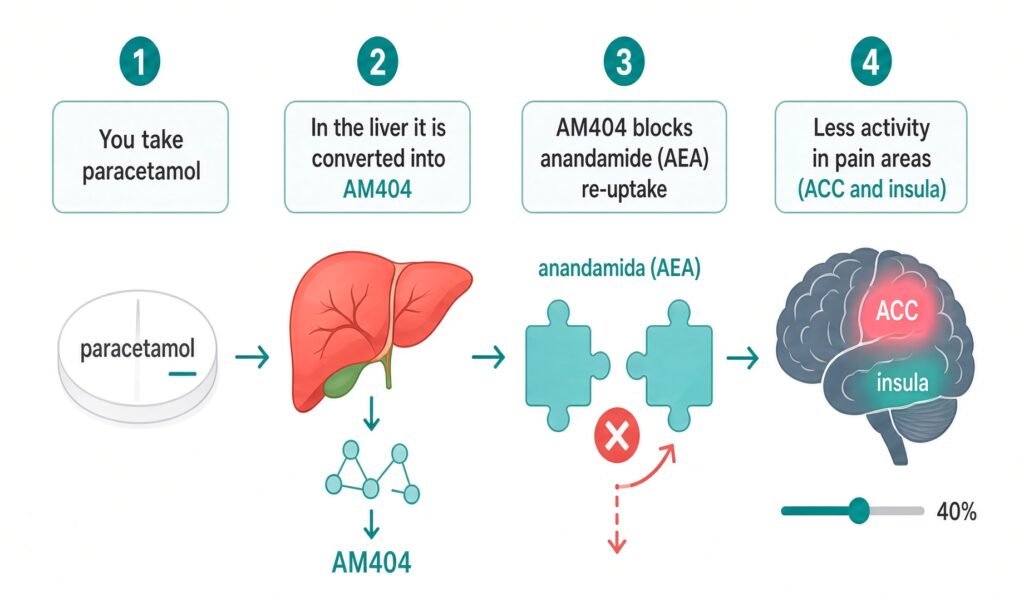
The chemical path, without invention: (1) Part of the paracetamol becomes p-aminophenol in the liver. (2) In the nervous system, the enzyme FAAH joins that metabolite to arachidonic acid and forms AM404. (3) AM404 blocks reuptake of anandamide, an endocannabinoid. More cannabinoid signal remains at the synapse. AM404 also touches TRPV1 and, weakly, CB1/CB2 receptors, and may inhibit COX-2 in microglia. (4) Central analgesia of paracetamol still uses descending serotonergic pathways.
Result in the adult: less affective alarm in the same regions that light up in physical pain. That is why the tablet can, at once, ease a headache and leave risk and empathy a little more opaque. Effect sizes in the psychology papers are typical of the laboratory (modest differences on scales), not emotional anaesthesia.
The hypothesis the empathy laboratories did not test
The conceptus brain is not a miniature adult. In the second and third trimesters — and in the perinatal period — the endocannabinoid system (ECS) helps regulate proliferation, neuronal migration, synapse formation and the calibration of circuits that later support sociability and affect. Paracetamol crosses the placenta.
It is legitimate to say: the same drug that, in the adult, leaves affective evaluation more opaque acts, via AM404, on a system (ECS) that in the fetus builds the circuits of sociability. That gives biological plausibility to study windows, dose and sex.
What exists on that link: formation of AM404 in the nervous system after paracetamol (classic Högestätt work and detection in human CSF). The ECS is necessary for brain development — that is developmental neuroscience, independent of paracetamol. In rats, gestational exposure to paracetamol altered neurodevelopment-type behaviours and the response to a cannabinoid agonist.
What does not exist: a human trial measuring ACC/insula or empathy in the child after the mother’s one-off use. Proof that the adult’s acute blunting is “imprinted” on the fetus. Consistency of direction: some autism-spectrum models describe low endocannabinoid tone, while AM404 in the adult raises anandamide in the short term. Chronic compensation is a hypothesis, not a datum.
The gap is not a conspiracy
The real gap is not “scientists hid the risk.” It is that affective psychopharmacology and perinatal epidemiology almost never meet, and the mechanistic link (fetal ECS) is still in the rat and in theory.
The Ohio State and UBC papers study decision and emotion in adults. They do not measure placenta, trimester or autism. Those who looked at pregnancy used another method: records of millions of births and, most important, sibling comparison (same mother, one child exposed and another not). In those designs the association with autism, ADHD and intellectual disability vanishes or is null — as in the Swedish cohort of Ahlqvist et al. (JAMA, 2024) and in the review of 43 studies by Khalil et al. (The Lancet Obstetrics, Gynaecology & Women’s Health, January 2026; in siblings, autism odds ratio 0.98).
A 2025 review using Navigation Guide methodology concluded an association and called for caution in use. That was the line cited in alerts in the United States. Recurring criticisms: it includes observational studies without adequate family control. ACOG, SMFM, EMA, UKTIS and Anvisa kept paracetamol as first line when there is pain or fever.
Two biases explain much of the old “association”: the fever and infection that motivate the tablet are already risks for neurodevelopment; and autism runs in families. Controlling siblings cuts both.
What this authorises — and what it does not
It authorises: research on critical window, cumulative dose, fetal sex and ECS markers. It authorises the mechanistic reasoning above, labelled as hypothesis.
It does not authorise: turning the Ohio State photo trial into an alert that the conceptus will be born “blunted,” or despairing mothers. It does not authorise leaving high fever untreated for fear of an adult laboratory effect. It does raise suspicion of whoever uses paracetamol repeatedly for any gestational symptom.
In doubt? Primum non nocere.
References
Affective blunting and decision in adults
1. Durso GRO, Luttrell A, Way BM. Psychol Sci. 2015;26(6):750-758.
2. DeWall CN et al. Psychol Sci. 2010;21(7):931-937.
3. Mischkowski D, Crocker J, Way BM. Soc Cogn Affect Neurosci. 2016;11(9):1345-1353.
4. Mischkowski D, Crocker J, Way BM. Front Psychol. 2019;10:538.
5. Keaveney A, Peters E, Way B. Soc Cogn Affect Neurosci. 2020;15(7):725-732.
6. Randles D et al. Soc Cogn Affect Neurosci. 2016;11(6):899-906.
7. Pickering G et al. Drug Des Devel Ther. 2016;10:2999-3009.
8. Pearson R et al. Soc Cogn Affect Neurosci. 2018;13(10):1029-1036.
9. Clayson PE et al. Cogn Affect Behav Neurosci. 2021.
10. Pickering G et al. PLoS One. 2015.
Mechanism (AM404 and endocannabinoid system)
11. Högestätt ED et al. J Biol Chem. 2005;280(36):31405-31412.
12. Sharma CV et al. J Pain Res. 2017;10:2703-2709.
13. Bührer C et al. Int J Mol Sci. 2021;22(20):11156.
14. Bauer AZ et al. Nat Rev Endocrinol. 2021;17:757-766.
Gestational exposure in animals
15. Gestational paracetamol exposure induces core behaviors of neurodevelopmental disorders in infant rats… Neurotoxicol Teratol. 2023.
Pregnancy, autism and clinical position
16. Ahlqvist VH et al. JAMA. 2024.
17. Khalil A et al. Lancet Obstet Gynaecol Womens Health. 16 January 2026.
18. Umbrella review. BMJ. 2025;391:e088141.
19. Prada D, Baccarelli AA et al. Environ Health. 2025. (Navigation Guide)
20. ACOG. Affirms safety and benefits of acetaminophen during pregnancy. Sept 2025.
21. SMFM. Acetaminophen remains first-line for pain and fever in pregnancy. 2026.
22. UKTIS; ENTIS. Position statements. 2025.
23. Anvisa. Note to the public: paracetamol and autism. 23 Sept 2025.
24. EMA; MHRA. Statements keeping paracetamol as an option in pregnancy. Sept 2025.
Note. There is no human clinical study that measured affective blunting in the fetus. This text is a narrative review for lay readers and professionals; it does not replace obstetric advice.


