

Isabel de Fátima Alvim Braga
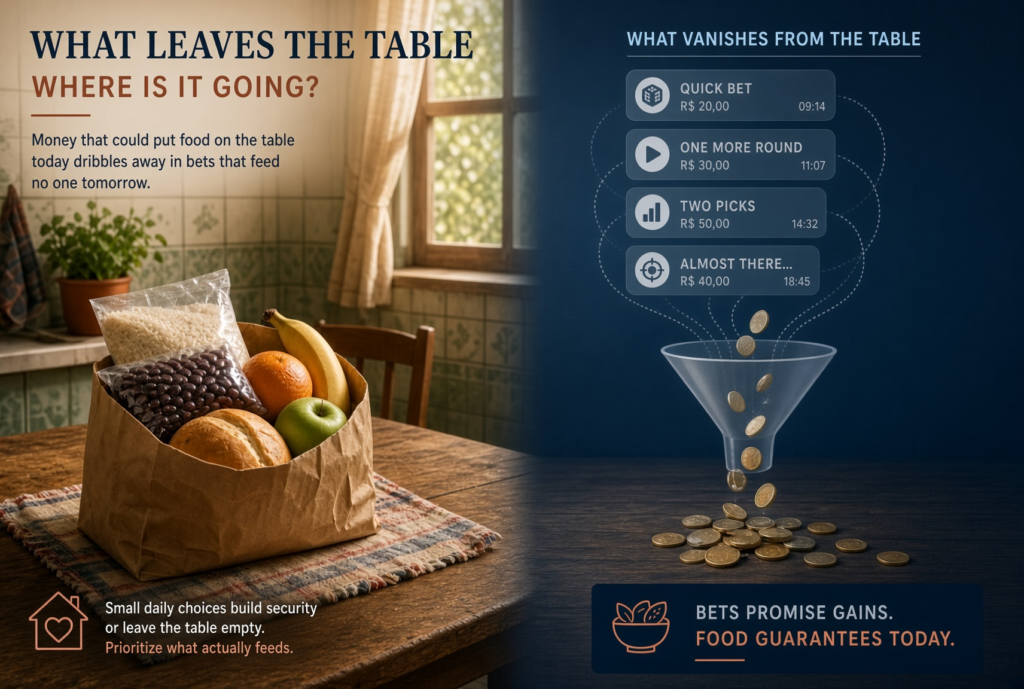
Figure 1. The same income disputes two destinations: the week’s grocery bag or the deposit in the app.
In 2025, the first full year of the regulated market, sports-betting GGR — stakes minus prizes — was R$36.96 billion. [1] Of that, 12% became legal earmarks: R$4.53 billion. [1][2] Sport took R$1.63 bn; tourism R$1.27 bn; security R$614 m; education R$460 m; social security R$454 m; health for gambling harm R$45.8 m. [2] The tax authority, adding corporate tax, PIS and Cofins, speaks of almost R$10 billion in sector tax in the year. [3] Large numbers in the fiscal speech. In GDP, another scale.
On the GDP side
IBGE closed 2025 with GDP of R$12.7 trillion and growth of 2.3%. Household consumption was R$8.1 trillion; agriculture R$775 billion. [4] Against that ruler: GGR of R$36.96 bn equals 0.29% of GDP. [1][4] Households’ net outflow, R$62.5 billion (what they staked minus what they got back, Comsefaz/Central Bank), is 0.49% of GDP and 0.77% of household consumption. [5][4] Guilherme Klein (UFRJ), applying a demand multiplier, estimates bets withdrew R$120 to 141 billion from activity — 0.9% to 1.1% of GDP, something like 40% to 50% of all 2025 growth. [6] In supermarket language: legal-sector GGR is on the order of 4.8% of agriculture’s value added that year. [1][4] Households’ net loss (R$62.5 bn) fits eight times into Sergipe’s GDP and exceeds four small states added together, as Estadão already noted. [5] The social earmark of R$4.53 bn is 0.036% of GDP — 12 cents in each R$1,000 produced in the country.
| 2025 magnitude | R$ billion | % of GDP (R$12.7 tn) |
| GDP (IBGE) | 12,700 | 100 |
| Household consumption | 8,100 | 63.8 |
| Betting GGR (SPA) | 37.0 | 0.29 |
| Households’ net outflow (Comsefaz) | 62.5 | 0.49 |
| Estimated activity effect (UFRJ) | 120–141 | 0.9–1.1 |
| Legal earmark 12% of GGR | 4.53 | 0.036 |
| Total sector taxes (Receita) | 9.95 | 0.078 |
Table 1. Scale: betting tax is visible at the Treasury and almost invisible in GDP; household loss is the opposite.
On the food side
The National Basic Basket Survey (DIEESE/Conab) measures the cost of feeding one adult, not a family. In September 2025 the dearest basket was in São Paulo at R$842. [7] In June 2026 it already passed R$965 in the same capital; in July it receded to R$915. [8][9] Take R$800 as a conservative adult anchor for the 2025–2026 cycle, mid-distribution of the capitals.
R$62.5 billion of net loss in 2025 buys about 78 million monthly adult baskets — or 6.5 million baskets for the whole year. Divided by the 25.25 million unique tax IDs that bet in the regulated market, [1] average loss is R$2,474 per bettor in the year, R$206 a month. That is a quarter of an adult R$800 basket, every month, on average. It is not the account of whoever deposits R$20 on Sunday. It is the average pulled by whoever loses a lot.
Household monthly spending on bets, in the CNC series, went from R$4 billion in January 2023 to R$29 billion in December 2025. [10] CNC associates each R$1 bn in bets with 0.7% less retail turnover. [10] Bettors’ reports: 4.3% said they had stopped buying food; 8.1% had stopped paying a bill. [11] That is not the majority. It is the tip where the habit already eats the essential.
Who feels it more: volume versus wound
There are two maps, and they do not coincide.
Map 1 — who appears in the base. Globo/observatory-style survey: class C is the largest slice of bettors (45%), class B 27%; A and D/E smaller. [12] Almost half declare income between R$1,519 and R$4,524; 63% say they spend up to R$100 a month. [12] Legitimuz white paper on the verified base: mean presumed income R$2,500; 75% in classes D and E; 73% between R$1,500 and R$3,000; credit score near 300. [13] In the Federal District, 32.5% of bettors are lower-middle income and 28.4% low income. [14]
Map 2 — who generates the house’s revenue. Legitimuz itself separates: D and E generate account volume; large deposits — and therefore more GGR — sit in A and B. [13] Anbima describes four profiles: C/D/E women in “Fortune Adept” and “Lion Killer” (the latter bets to close the electricity bill); A/B men in the hobby and the “expert” who treats the bet as an investment. Of 28.3 million who bet in the Anbima cut, 4.5 million believe a bet is an investment. [15]
The most numerous class in the app queue is C/D. The most wounded class, as a share of income, is the same: whoever earns R$2,500 and loses R$206 in the average month (or far more in the high percentile) is taking it from the basket, not from a multimarket fund. Class A/B loses more reais and less life. It is the pattern of a good with dependence: social harm concentrates where income is inelastic — rent, market, bus fare.
Klein uses exactly that in the multiplier: a low-income family consumes almost everything that comes in; each real that leaks to the bet vanishes twice — once at the table, again in neighbourhood commerce. [6] That is why the GDP effect (R$120–141 bn) is larger than the accounting net loss (R$62.5 bn). Retail feels the second number; GDP, the first.
What the R$4.53 bn does not offset on its own
The legal earmark is real public policy: R$1.63 bn in sport, R$460 m in education, R$45.8 m in player health. [2] Compared with household loss, gambling health took 0.07% of that R$62.5 bn. Education took 0.7%. Sport, the largest beneficiary, took 2.6% of what families lost — and part of that returns as a shirt with the bet’s own logo.
The R$30 million five-year licence fee is an entry toll, not an annual earmark. [16] The Selective Tax from 2027 may add another layer, estimated around R$6 bn if the rate walks near 15%. [17] None of that changes the 2025 mechanism: the real leaves the family’s Pix first and only then becomes GGR, tax and a stamp.
How to read without mixing
Three sentences fit together. The legal sector is relevant to the Treasury (~R$10 bn). It is small in GDP (0.3% of GGR). It is large in the budget of whoever earns up to three minimum wages. The honest comparison of the R$4.53 bn earmark is not with the Union budget; it is with the 78 million adult baskets the net loss would buy, and with the fact that the poorest tip of the base is, at once, the most numerous and the least able to absorb the average R$206 — or the deposit that is not average.
References
[1] Secretariat of Prizes and Bets / Finance Ministry. Regulated-market report, 1 Jan–30 Dec 2025. GGR R$36,959,783,379.70; earmarks R$4,532,797,794.92; 25,245,319 unique tax IDs.
[2] SPA/MF, 2025 earmark breakdown (reproduced in market studies): Sport R$1,625,543,103; Tourism R$1,267,510,862; Security R$614,368,595; Education R$459,542,800; Social security R$454,435,647; Health R$45,751,662; Funapol R$25,116,850; civil society R$22,423,906; ABDI R$18,104,369.
[3] Federal Revenue. 2025 sector collection about R$9.95 billion; Jan–Jul 2026 R$8.7 billion.
[4] IBGE. GDP grows 2.3% in 2025 and closes the year at R$12.7 trillion. Household consumption R$8.1 tn; agriculture R$775.3 bn. 3 Mar 2026.
[5] Comsefaz / Estadão / G1. Households’ net outflow to bets: R$62.5 billion in 2025 (0.68% of disposable income).
[6] Klein, G. (UFRJ). Estimated activity loss R$120 to 141 billion in 2025 (0.9%–1.1% of GDP). BBC Brasil, 24 Aug 2026.
[7] DIEESE/Conab. National Basic Basket. São Paulo, Sep 2025: R$842.26.
[8] DIEESE/Conab. June 2026. São Paulo: R$965.47 (64% of net minimum wage).
[9] DIEESE/Conab. July 2026. São Paulo: R$915.01.
[10] CNC / VEJA. Each R$1 bn in bets associated with −0.7% in retail; household monthly spend R$4 bn (Jan 2023) to R$29 bn (Dec 2025).
[11] Correio Braziliense. Women with children who bet: 4.3% stopped buying food; 8.1% stopped paying a bill.
[12] Globo / observatory-style survey of bettor classes.
[13] Legitimuz white paper on the verified base.
[14] Federal District bettor income breakdown.
[15] Anbima. Four bettor profiles; 4.5 million of 28.3 million treat bets as investment.
[16] Five-year licence fee of R$30 million.
[17] Selective Tax from 2027; estimate near R$6 bn if the rate is near 15%.

 Português do Brasil