
When what the patient asks for is not death: it is the reduction of pain and suffering
Isabel Braga, MD phD
Hawking, prognosis, and the window that is not destiny
In 1963, at 21, Stephen Hawking heard from doctors that he had about two years left. He had amyotrophic lateral sclerosis, ALS. The body would stop. The brain would not. He died in 2018, at 76: 55 years beyond the deadline. In that interval he wrote A Brief History of Time, had children and spent decades asking for a little more universe.
There is no public remark of his on the day of diagnosis. What exists is the prognosis of that time and what he said later, looking back. In 2011, to The Guardian: “I have lived with the prospect of an early death for the last 49 years. I’m not afraid of death, but I’m in no hurry to die. I have so much I want to do first.”
In 2006, already famous and almost without movement, he stated the essential point: a person should have the right to end their own life — “but I think it would be a great mistake. However bad life may seem, there is always something you can do, and succeed at. While there’s life, there is hope.”
In September 2013, on the BBC, the tone changed, not the core. He defended the right of those with terminal illness and intense pain, and of those who help that person, without criminal prosecution. “We don’t let animals suffer, so why humans?” He asked for safeguards. He recalled that in 1985, with pneumonia and a tube, his wife was consulted about switching the machine off. He did not want to die then. The safeguard, he said, is to ensure the person really wants the end — and that no one pushes them.
In 2015, again to the BBC: he would consider assisted suicide only if he were in great pain or felt he had nothing more to contribute and was merely a burden on those around him. “Keeping someone alive against their will is the ultimate indignity.”
Hawking was not a saint against euthanasia. He was for the right, with a fence. Terminal illness. Intense pain. A genuine request. No pressure. His case does not prove the law is always wrong. It proves something else, more uncomfortable for those who legislate: prognosis is not destiny. The window in which someone asks to die may be exactly the window in which life has not yet shown what it was going to be.
The real request: stop the pain, do not erase who hurts
Palliative physician Manuela Conduru says that in her clinical practice in terminal care, comfort and pain control are essential. According to her, “the request — in the overwhelming majority of cases — is to kill the suffering, not the person. And the literature says that a good share of people pull back from the decision when suffering is reduced.”
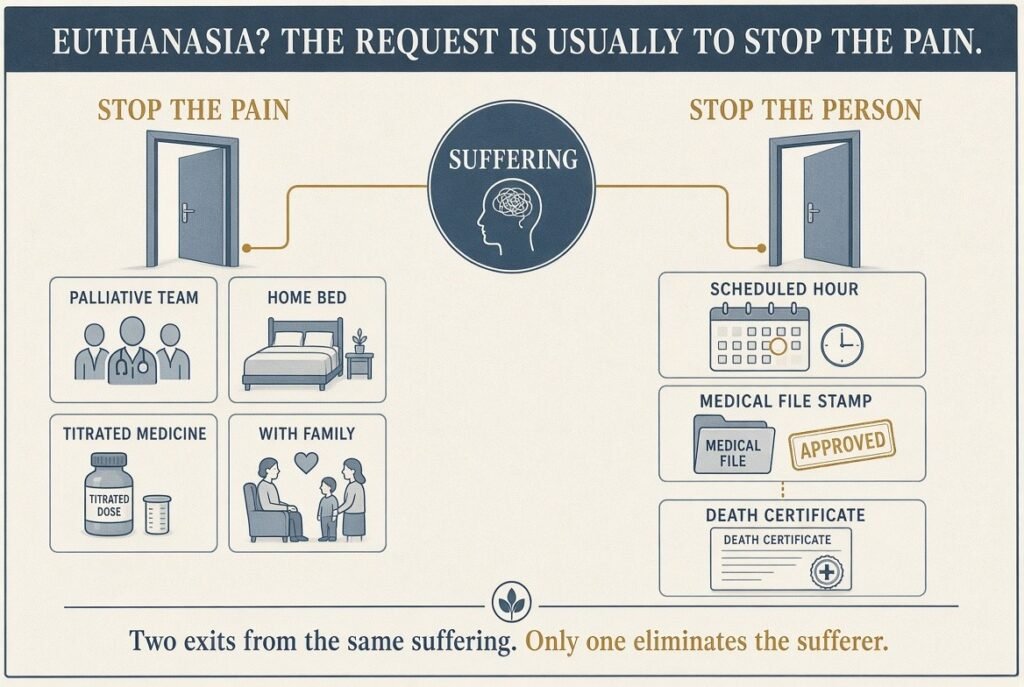
Almost no one asks “erase me” in a vacuum. They ask for the pain, the choking, the humiliation or the panic to stop. Those are two different objects. Pain is a state. It can be treated, sedated, accompanied, sometimes cured. Death is the extinction of the one who feels.
Euthanasia solves the first by destroying the second. It is effective in the same way as silencing an alarm by breaking the clock. The alarm goes. The problem the alarm announced — illness, loneliness, a house without a ramp, a psychiatry queue — remains in the world. It only changed owner: now it belongs to those who stay.
If the stated goal is to stop the pain, the first treatment is the pain — not the patient. Palliative care, analgesia, sedation, a team at home, crisis psychiatry exist for that. Calling both exits “care” mixes hospice with medical homicide. Stopping the pain leaves a patient. Stopping the patient leaves a certificate.
Euthanasia and suicide: same direction, different ritual
At bottom, both are intentional death. The difference is institutional. In suicide, the person acts alone; helping is usually a crime; the certificate says suicide; the social gesture is to prevent. In assisted suicide, the person takes the drug the doctor hands over. In euthanasia — the Dutch, Belgian and most Canadian model — the doctor injects. There is an opinion, a commission, a timetable, a white coat. The certificate often does not enter the suicide count.
That statistical split matters. If a country takes assisted death out of the “suicide” heading, official suicide can look stable or even fall while chosen deaths rise. One is not comparing the same thing. Anyone who uses only the classic suicide rate to say “the law did not increase voluntary deaths” is looking at the glass without the water that went into another glass.
There is also the asymmetry of the young. A suicide attempt in the emergency room produces restraint, admission, a crisis plan. The same wish, stamped “irremediable suffering,” can produce an appointment. The incoherence is not subtle: the system blocks the act at one door and organises the act at the other.
Those who defend the distinction say: suicide is born of a treatable disorder; euthanasia would be born of a lucid judgement about illness with no way out. The problem is the law. Once opened to subjective suffering — “unbearable for me” — the border does not hold by itself. So-called refractory depression, autism with suffering, tiredness of living enter through the same gate as cancer. And it scales.
What the laws promised and what official numbers show
The sales argument was almost always the same: rare cases, the dying, physical pain, a lucid person who asks several times. The text of the law, however, rarely stayed tied to “terminal illness.”
Netherlands, 2002: the law never required terminality. It required unbearable suffering with no prospect of improvement. That already fitted chronic disease, dementia and psychic suffering. From 12 to 15 years, parental consent; from 16 to 17, parents involved. Newborns: the Groningen Protocol. In 2024 the government regulated the 1-to-12 age band, with restricted criteria and parental consent.
Belgium, 2002: the same logic. In 2014 it removed the age limit for minors capable of discernment, with extra criteria — constant physical suffering, death in the short term, parents and a child psychiatrist.
Canada, 2016: started with death “reasonably foreseeable” (now called Track 1). In 2021 Parliament created Track 2: a serious illness and intolerable suffering even when natural death is not near. Mental illness as the sole ground was marked for 2023, postponed to 2024 and then to March 2027. In June 2026 a joint House–Senate committee asked for indefinite exclusion of that expansion. The government still decides.
The annual cases
The numbers below come from the official commissions: Regionale Toetsingscommissies Euthanasie (RTE) in the Netherlands; the federal Control and Evaluation Commission in Belgium; Health Canada in the annual MAID report. They are reported cases, not estimates.
Figure 2 in the original: annual reported cases. Sources: RTE, Belgian commission and Health Canada. Canada legalises in 2016; Track 2 enters in 2021.
Netherlands. In 2003, the first full year of the law, 1,815 cases. In 2023, 9,068 (5.4% of deaths). In 2024, 9,958 (about 5.8%). In 2025, 10,341 — 5.97% of the country’s 173,314 deaths, according to a letter from the health minister based on the RTE. In 25 years the annual number moved from the 2,000 range to the 10,000 range.
Belgium. In 2003, 235 cases (0.22% of deaths). In 2023, 3,423 (3.08%). In 2024, 3,991 (3.6%). In 2025, 4,486 (4% of deaths). The federal commission recorded a rise of 16.6% in 2024 and 12.4% in 2025.
Canada. In 2016, 1,018 MAID provisions. In 2022, 13,241. In 2023, 15,343 (4.7% of deaths, Fifth Report). In 2024, 16,499 — 5.1% of deaths, up 6.9% on 2023, in Health Canada’s Sixth Report. Since 2016: 76,475 provisions. It was the country with the steepest early rise (several years above 30%). The curve now slows. It does not vanish.
Reading only the absolute number misleads: populations and total deaths differ. The share of deaths is the figure that allows comparison. In all three countries it rises. In Canada, in eight years, it reached a plateau the Netherlands took more than two decades to cross.
What changed inside the box: the causes
It was not only volume that rose. The cast changed. Official reports repeat the same shift: cancer remains first but loses share; combinations of illnesses (polypathology), dementia and, on a smaller scale, psychic suffering rise. So do cases in which natural death was not expected in the short term.
Netherlands, RTE 2025. In 85.35% of the 10,341 cases there was common physical disease — cancer, nervous system, lung, heart. Dementia: 499 cases (427 in 2024). Accumulation of age-related ills: 475. Psychic suffering: 174 in 2025, against 219 in 2024 (a drop of almost 21%). Of those 174, 19 were under 30 (they were 30 in 2024). No minor for a psychic reason in 2025. One minor aged 12 to 18 for physical disease. Seven dossiers judged without due care. Cancer, which in the late 1990s reached about 90% of cases, was around 54% in 2024, according to a study commissioned from Radboudumc and other centres.
Belgium, federal commission. In 2024: cancer 54%; polypathology 26.8% and rising; severe neurological disease 8.1%; psychiatry 1.4%; cognitive disorders 1.4%. In 76.6% death was expected in the short term; in the rest, 932 cases, death was not imminent (713 in 2023). In 2025: cancer 49.9%; polypathology 29.6%; neurological 8.2%; psychiatry 1.6%; cognitive 1.7%. Cases without short-term death: 1,117. Majority over 70 (73.7%); 45% over 80. Under 40: 1.4%.
Canada, Sixth Report, 2024. Track 1 (foreseeable death): 15,767 cases, 95.6%. Track 2 (death not foreseeable): 732 cases, 4.4%. Cancer remains the most cited condition — in the 2023 report it passed 60%. Median age in 2024: 77.9 years. About 74% to 75% had some palliative care. That does not prove the palliative care was complete: a fraction had it only briefly. Almost half cited feeling a burden on family, friends or carers, a high mark already seen in earlier years.
| Official figure | Netherlands | Belgium | Canada |
| First year of law | 2002 / 1,815 in 2003 | 2002 / 235 in 2003 | 2016 / 1,018 |
| Latest published year | 2025: 10,341 (5.97%) | 2025: 4,486 (4%) | 2024: 16,499 (5.1%) |
| Leading cause | Common physical ~85% (2025) | Cancer 49.9% (2025) | Cancer (most Track 1) |
| What is rising most | Polypathology, dementia | Polypathology 29.6% | Track 2 still a minority |
| Isolated psychiatric | 174 in 2025 (219 in 2024) | ~1.6% in 2025 | Not yet in force (set for 2027) |
| Minors | 1 case 12–18 in 2025; 1st case 1–12 late 2025 | 7 since 2014 (1 in 2024 and 1 in 2025) | Not eligible under 18 |
Children and adolescents: rare, but the principle is already in the law
In Belgium, since 2014, seven minors in total. One in 2024 and one in 2025. Criteria for a minor are harder than for an adult: physical suffering, death in the short term, capacity to discern, parents and a child psychiatrist. On paper it is not “an adolescent in a mood crisis.” It is serious disease. The low number does not erase the fact: the country was the first to remove the age limit.
In the Netherlands, the RTE recorded in 2025 one adolescent aged 12 to 18 for physical disease. The 1-to-12 band, regulated in 2024, had its first case at the end of 2025: a child of almost 2 years, extreme prematurity, severe brain injury, cerebral palsy and visual impairment. The special commission found the doctor acted with due care; the Public Prosecution Service also reviews, as in every death of this type. When the rule was made, the government spoke of five to ten cases a year. So far, one.
Canada, Spain and most of the newer countries do not include anyone under 18. There is debate about the “mature minor.” The law has not yet opened.
Cases that did not fit the poster for the law
The official majority remains older people with cancer. That is true and needs to stay said. What the press documented — and what the commissions later confirmed — is another slice: infant, child, adolescent, depressed person, autistic person, a veteran who was offered death when the request was a ramp. They are not the average. They are the test of the limit. Below, only what has a name in a newspaper, an age in a report or a commission dossier. Nothing invented.
Infants and small children
Before the 2002 law, Dutch neonatologists already ended the lives of newborns with extreme malformation. Between 1997 and 2004, 22 cases were reported to prosecutors; all with very severe forms of spina bifida. No doctor was prosecuted.
A national survey of the time spoke of 15 to 20 cases a year — that is, most were not reported. In 2004–2005 the Groningen Protocol described when this could occur: certain diagnosis, suffering with no prospect, a second doctor, consent of both parents, procedure to medical standard. After the protocol the reported number collapsed: three cases in 18 years, according to a review published in 2025. Anyone speaking of “hundreds of babies a year” today is repeating a figure later official data do not support.
What returned to the front page in 2026 was the next age band. In 2024 the Netherlands regulated children aged 1 to 12. At the end of 2025 the first case occurred: a child of almost 2 years, born at 26 weeks, severe brain injury, cerebral palsy and visual impairment. Minister Sophie Hermans informed Parliament. The special commission concluded the doctor acted with due care. The Public Prosecution Service reviews, as in every death of this type. When the rule was made, the government spoke of five to ten cases a year. So far, one.
Children and adolescents with physical disease — Belgium
The Belgian federal commission’s 2016–2017 report, published in 2018 and picked up by Le Soir and the Library of Congress, recorded three minors: 9, 11 and 17 years. The diseases, according to the commission itself, were severe Duchenne muscular dystrophy; a malignant tumour of the eye, brain and central nervous system; and cystic fibrosis. The commission wrote that they suffered from incurable conditions that would lead to death in the short term and approved all three dossiers unanimously. Wim Distelmans, then chair of the commission, said “there is no age for suffering.”
Critics asked whether cystic fibrosis, whose median survival in rich countries already exceeds 40 years, was always “death in the short term.” The commission kept the framing. Since 2014 the official total reached seven minors (one in 2024 and one in 2025). The names are not public.
Adolescent and young adult with psychic suffering — the Netherlands
On 2 October 2023, in the Netherlands, Milou Verhoof, 17, received the injection in her childhood bedroom. She suffered severe psychic suffering (the press cited a personality disorder; a Dutch documentary the following year made the case the most-watched on television). Psychiatrist Menno Oosterhoff concluded the suffering was unbearable and without prospect. The parents were in the room. The RTE judged the dossier careful.
Milou was the country’s first minor euthanised for psychic suffering. In the same year there was a second minor by the same route, according to the RTE and EenVandaag. In 2024, 30 people aged 15 to 29 died by euthanasia for a psychic cause — 3.1% of deaths in that age band, according to Dutch data picked up by The Atlantic. In 2025 the psychic total fell from 219 to 174; those under 30 in that category were 19; no minor.
Before Milou, the press already had two names of young adult women: Aurelia Brouwers, 29, dead in 2018 after years of depression, anxiety and borderline personality disorder; and Zoraya ter Beek, also 29, with a similar picture, dead in May 2024.
The Associated Press and a study in BJPsych Open described, among public RTE dossiers, a man with autism in his twenties: unhappy since childhood, bullied, “longed for social contact but could not connect.” He decided that living that way for years would be an abomination. Eight of 39 dossiers with autism or intellectual disability cited only factors linked to that — isolation, lack of strategies, rigidity of thought — as the cause of unbearable suffering. Thirty cited loneliness among the causes.
Who asks and then withdraws — the number the average hides
A request is not a death. That too is official data, and it is the opposite of the poster of “inevitable relief.”
A cohort study in JAMA Psychiatry (2025) followed 397 requests for assisted death for psychic suffering made by 353 Dutch people under 24, between 2012 and the first half of 2021. Result: 47.3% of requests were withdrawn by the young person; 44.8% were refused; 12 people (3%) died by euthanasia; 17 (4.3%) died by suicide during the process; 2 stopped eating and drinking.
Those who died — by euthanasia or by suicide — had several diagnoses at once (median of four): depression, autism, personality disorder, eating disorder, trauma. At the law’s front door, almost half withdraw. A fraction kill themselves while waiting. A minimal fraction complete the protocol. Treating a depressed adolescent’s request as a stable will is precisely what this cohort does not show.
In Canada the Sixth Report (2024) records 692 people who withdrew a MAID request that year (574 in 2023). Another 4,017 who asked died of another cause before the provision — most on Track 1. Sixty-eight withdrew at the moment before the injection. Withdrawal exists. The question is whether the system offers time and treatment for that withdrawal to happen, or only the appointment.
Depression and a family that only learned afterwards — Belgium
Godelieva De Troyer, 64, physically healthy, with depression her doctor considered incurable, died by injection in Brussels in 2012. Her son, Tom Mortier, a university professor, learned when the hospital called asking him to collect the body from the mortuary. He went to the European Court of Human Rights. In 2022 the court did not strike down the Belgian law, but pointed to procedural failures in the review commission and asked for more safeguards.
Tine Nys, 38, died on 27 April 2010. Doctors spoke of psychic suffering since puberty, borderline personality and autism. Her sisters told the courts and television that the trigger had been the end of a relationship, that she had been without psychiatric treatment for 15 years and that autism had been diagnosed late, still without therapy. They described the scene: the doctor compared the death to that of a pet, asked the father to hold the needle because he had forgotten tape and, afterwards, whether the parents wanted to hear the stopped heart on the stethoscope.
In 2020 the Ghent jury acquitted the three doctors of poisoning. The family also lost the civil action. It was Belgium’s first criminal trial of euthanasia. Wim Distelmans said some doctors had stopped even cancer cases for fear of the court.
When the request was a ramp, a house or a veteran — Canada
Christine Gauthier, a veteran and Paralympic athlete, told a House committee she asked for help to build a wheelchair ramp and heard an offer of MAID — more than once. The minister of Veterans Affairs admitted before the same committee, in 2022, that a social worker offered MAID to at least four veterans; a fifth case appeared in the press. There was a suspension and a referral to police. Later the minister tried to say the department “never offers MAID.” The contradiction remained on the parliamentary record and in the National Post.
The Associated Press described the file of Mrs B, in her fifties, with multiple chemical sensitivity, a history of mental illness and isolation: she asked to die chiefly because she could not obtain adequate housing. The Ontario death-review committee split. Some said social need is not a legal criterion. Others, that “social need can be irremediable” if alternatives have been explored.
Kiano Vafaeian, 26, in Toronto, blind from complications of type 1 diabetes, with depression, in public housing. Not terminal. His mother, Marsilla, learned the MAID request had been approved and described the scene as dystopian. Critical doctors used the case to say what the annual report already hints at in aggregate: social suffering enters the form glued to a physical diagnosis, because isolated mental illness is not yet legal.
None of this proves that “everyone who asks for MAID in Canada is poor.” The majority remains an older person with cancer on Track 1. It proves the other, smaller, documented fact: when the law unhooks death from terminality, the door fits those who asked for a ramp, a house or a reason not to feel a burden.
If it is to stop the pain, why is the pain not stopped?
Palliative care exists to relieve pain, breathlessness, delirium and fear without using death as the means. Palliative sedation can reduce consciousness until natural death. The incoherence begins when the system speaks the language of relief and first offers the cheapest and fastest tool in the catalogue.
Canadian reports say about three quarters of those who receive MAID had some palliative care. Advocates use that to say there is no substitution. The detail is another. “Had palliative care” can mean days, not real follow-up. And Canadian law does not require the doctor to exhaust alternatives: it is enough that the patient finds the conditions of relief “unacceptable.” In the Netherlands the doctor must agree there is no other reasonable path. Those are opposite philosophies.
A simple policy test: a country that legalises death without universalising relief is answering the wrong question. If the goal is pain, the first investment is a 24-hour team, well-titrated opioid, a hospice bed, an adapted house, a psychiatrist. Scheduled death has no queue. Palliative care sometimes does.
Where the bodies go — and what organ donation has to do with it
There is no cellar. There is a funeral, cremation — and, in some countries, an operating theatre.
Since 2012 there has been a named flow: organ donation after euthanasia (ODE; in Canada, donation after MAID). The person has already been approved to die. Then they ask, or accept, to donate. The classic rule on paper is still this: first death, then the cut. Organs are not taken from the living. One waits for the heart to stop, plus a few minutes, and only then opens.
This is legal in the Netherlands, Belgium, Canada, Spain and Australia. It is not compulsory. Anyone who says “euthanasia is approved only for those who donate” is inventing.
The public numbers, however, are not small.
In the Netherlands, a study with RTE data from 2012 to early 2025 found 166 donations after euthanasia among 3,615 post-mortem donations — 4.6% over the period. The annual share rises: 8.2% in 2023, 9.7% in 2024 and 10% in 2025 to the date of the paper. Of those 166 cases, 79 were physical suffering, 73 psychic suffering and 14 early-stage dementia. From them came 39 hearts, 114 lungs, 110 livers, 31 pancreases and 304 transplanted kidneys.
In Spain, the National Transplant Organisation counted, from 2021 to 2025, 226 people who donated after euthanasia and 643 transplants. In 2024, of 426 euthanasias, 63 donated — 14.8%, the highest rate among countries that do this. In the same year, by the same comparison: Canada, 16,499 MAID and 62 donors (0.38%); Belgium, 3,991 and 13 donors (0.32%); Netherlands, 9,958 and 32 donors (0.32%). Spain donates more because it was already the world champion of donation, not because the others hide bodies.
In Canada there is a national guideline (Canadian Blood Services / CMAJ, 2019, updated in 2023): the organ conversation only after the decision to die. In Quebec, the share of donors among MAID deaths rose from 4.9% to 14% between 2018 and 2022. A liver study at six Canadian centres (2016–2023) found 56 transplants with an organ after MAID and a result similar to classic donation after cardiac arrest.
WHO already has a heading for this: DCD type V — “medical assistance in dying or euthanasia.”
The ethical debate fits in four sentences.
First: setting the hour of death and, in the same flow, the hour of the graft strains the dead-donor rule. That is why the five-minute wait.
Second: almost half of the 166 Dutch cases were psychic suffering. Depression or autism, on paper “irremediable,” become multi-organ donors. The yearbook records. It does not judge.
Third: if the system offers donation to those who ask for MAID — in some Canadian provinces everyone is approached; in others, only if the person starts the subject — the safeguard “first die, then donate” thins.
Fourth: in 2025–2026 Canadian doctors discussed, in an article, killing by organ retrieval in someone already approved for MAID — without the classic injection. They call it “death by donation.” It is not law. It is a paper. The current guideline still separates the two.
There is no public evidence of trafficking, of euthanasia done to stock a waiting list, or of a government paying for an organ. What the numbers will bear is drier: the body does not vanish; it enters a minute. Death is cheap. If a kidney comes, the transplant system gains a donor. In the recent Netherlands, one in ten post-mortem donations already comes from this flow.
Stopping the pain leaves a patient. Stopping the patient sometimes leaves a graft.
What the reading allows
If Hawking were 21 today, with early ALS, in several of these countries he would fit the medical criterion. ALS is exactly the kind of disease with a high rate of assisted death. He lived 55 years beyond the deadline. No one can know in advance who the next Hawking will be. The law, however, acts as if it knew — or as if that did not matter.
He accepted the right and refused the haste. He tied the right to terminal illness and intense pain. He asked that no one be switched off unwillingly, as almost happened to him in 1985. The 2006 sentence remains the best brake in one line: the right may exist; using it too early is a great mistake; while there is life, there is hope.
The question that remains is not “are you for or against the death of someone who is ending in pain without relief.” It is this, drier: if it is to stop the pain, why is death more available than relief? Why do the suicide certificate and the MAID certificate not add in the same account? Why does “being a burden” appear on the form next to cancer?
Stopping the pain is medicine. Stopping the one who hurts, when there was still something to try against the pain, is another profession wearing the same coat.
Isabel de Fátima Alvim Braga – This article interprets public documents and official reports. It is not a clinical protocol.
Sources
Primary sources or papers that cite the commissions. 2024–2025 figures follow official communiqués and yearbooks available in 2026. Small differences of 1 to 20 cases between a report and the next year’s revision are normal: commissions correct late dossiers.
Netherlands — RTE. Jaarverslag 2025 and Kerncijfers 2025: 10,341 notifications; 5.97% of deaths; 174 psychic cases; 19 under 30; no minor for a psychic reason; 499 dementia; 475 age-related ills. Letter from minister Sophie Hermans to Parliament on the 2025 yearbook. Prior yearbooks: 9,958 (2024), 9,068 (2023), 8,720 (2022). Series 2003–2025 compiled from RTE / Staat van Volksgezondheid en Zorg.
Belgium — Commission fédérale de Contrôle et d’Évaluation de l’Euthanasie. 2024 communiqué (3,991 cases; 3.6% of deaths; 1 minor; total of 6 minors since 2014) and 2025 (4,486 cases; 4% of deaths; 1 minor; total of 7). Causes 2024–2025; cases without short-term death 932 (2024) and 1,117 (2025). Series 2003–2023 in Wels J, Hamarat N. JAMA Netw Open. 2025.
Canada — Health Canada. Fourth Annual Report on MAID (2016–2022: 1,018; 2,838; 4,493; 5,665; 7,611; 10,092; 13,241). Fifth, 2023: 15,343; 4.7% of deaths. Sixth, 2024: 16,499; 5.1%; Track 1 15,767 (95.6%); Track 2 732 (4.4%); cumulative 76,475. Median age 77.9. Palliative care in about 74–75% of cases.
Minors, Netherlands 1–12 — Letter from minister Sophie Hermans to the Tweede Kamer, June 2026, on the first 1–12 case (late 2025). NOS / NL Times, 23 June 2026; special commission found due care in the case of the child of almost 2 years (NL Times, 9 Sept. 2026).
Hawking — The Guardian, 17 Sept. 2013; BBC News, 17 Sept. 2013; The Guardian, 3 June 2015; The Guardian, May 2011; New York Times, 14 Mar. 2018 (2006 statement on right, error and hope).
Donation after euthanasia — Bollen et al. and Dutch ODE manuals; 2012–early 2025 summary in Transplantation (abstract 306.3, 2025): 166 ODE in the Netherlands; rising share of post-mortem donations; 73 psychic cases among the 166.
Costs — Trachtenberg AJ, Manns BJ. CMAJ. 2017. Parliamentary Budget Officer. Cost Estimate for Bill C-7, 2020 (~C$149 million projected net saving). The 2025 Journal of Death and Dying paper (Jamil and Pearce) citing C$1.273 trillion is a hypothetical scenario, not a government plan; AFP Fact Check and Health Canada treated the viral reading as false.
Canadian committee, 2026 — Joint House–Senate report, 17 June 2026: recommend indefinite exclusion of people whose only condition is mental illness. Coverage: CBC, Globe and Mail, BBC.
Palliative care and legal test — Health Canada annual reports. Canada vs Netherlands on exhausting alternatives: CMAJ / analyses of Bill C-14.
Press cases and dossiers — Belgium, minors 9, 11 and 17 (2016–2017): CFCEE 2018 report; Le Soir, 17 July 2018; Library of Congress Global Legal Monitor, 29 Oct. 2018. Tine Nys (2010): BBC, 31 Jan. 2020. Godelieva De Troyer (2012) and Tom Mortier: The Times, 4 Oct. 2022; ECtHR Mortier v. Belgium.
Press cases — Netherlands: Milou Verhoof, 17, 2 Oct. 2023: EenVandaag; The Atlantic, Mar. 2026; The Telegraph, 8 June 2024. Aurelia Brouwers (2018) and Zoraya ter Beek (2024): The Telegraph, 8 June 2024. Autism/intellectual disability in RTE dossiers: AP, 28 June 2023; BJPsych Open, 2023. Requests by people under 24: JAMA Psychiatry, 2025 (397 requests; 47% withdrawn; 12 MAID; 17 suicides in process). Groningen Protocol: Verhagen and Sauer, N Engl J Med, 2005 (22 reported cases); 2025 review (3 cases in 18 years after the protocol).
Press cases — Canada: Christine Gauthier and veterans (VAC): House committee testimony, 2022; National Post, 19 Dec. 2022. Mrs B and social need: Associated Press, 16–17 Oct. 2024. Kiano Vafaeian: The Free Press, 22 Feb. 2026. Withdrawn requests: Health Canada, Sixth Annual Report, 2024 (692 withdrawals; 4,017 deaths from another cause before provision).
Dutch long-term trend — Radboudumc / UMC Utrecht / Amsterdam UMC research for the Health Ministry, reported by NOS (2026): from ~1.6% of deaths in 1999 to 5.8% in 2024; cancer from ~90% to ~54% of cases.

 Português do Brasil