



Isabel de Fátima Alvim Braga

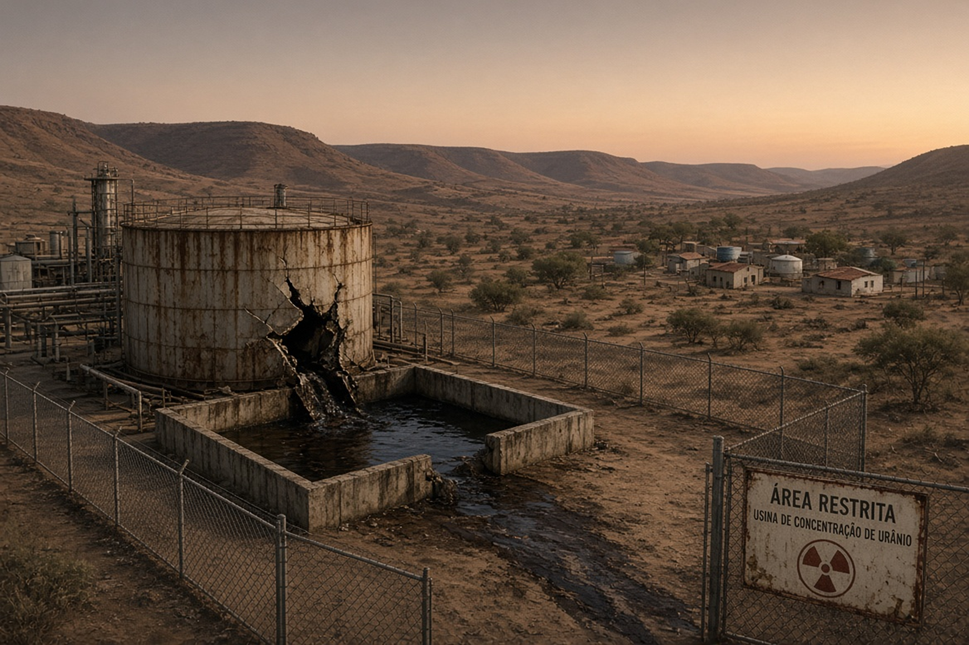
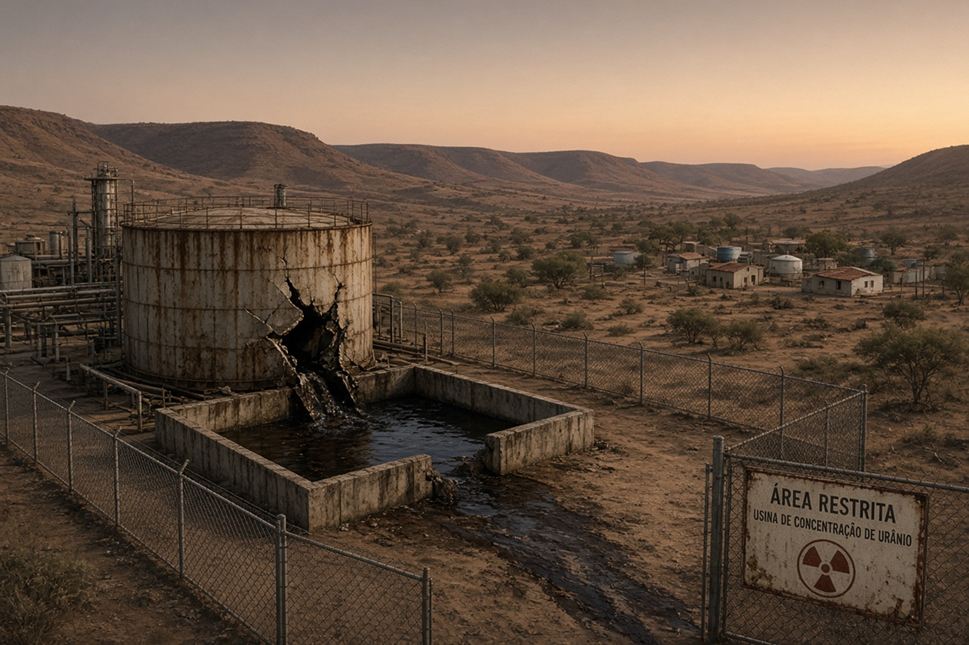
This is not Angra. It is Caetité, south-west Bahia: the Uranium Concentrate Unit of Indústrias Nucleares do Brasil, the only operating uranium mine in the country. Yellowcake leaves that pit, goes to Europe for conversion, and returns as fuel for the plants on the Costa Verde. That chain was already on this masthead.
Portuguese: A mina, a torta e as ampolas.
English: The mine, the cake and the ampoules.
What ANSN put on paper on Tuesday
On the afternoon of 22 September 2026 a reservoir failed at the URA. Brazil’s National Nuclear Safety Authority halted the area. CNN carried the statement: capacity of 20,000 litres; process liquor set aside for chemical treatment; the area was not running at the time; no one injured; “no impact outside the installation”; cleanup, sampling, monitoring.
Two sentences in that statement do not fit one slogan. First: most of the liquid stayed in the plant’s containment. Second: a portion reached adjacent ground inside the unit.
Capacity is not volume spilled. ANSN did not say 20,000 litres left the tank. It said the tank holds 20,000. Until the measured volume is published, “twenty thousand in the sertão” is a ceiling, not a reading.
The authority promised further information when the technical assessments are done. As of this edition there was no public soil result, no water result, no map of the adjacent patch and no INES rating.
Twelve days
On 10 September 2026 Ibama renewed Operating Licence 274/2002 for ten years — the third renewal. It covers mining at Mina do Engenho and milling. Twelve days later the tank opens.
On 20 May the Federal Prosecution Service had told Ibama not to renew without prior, free and informed consultation of at least 14 quilombola communities within 20 kilometres, in Caetité and Livramento de Nossa Senhora, ILO Convention 169. Ibama renewed. The consultation, on the public paper, did not close.
The same sentence, other years
April 2000, months into operation: about five million litres of liquor from the ponds. INB did not notify. Prosecutor Jailson Trindade and the public ministry pulled the thread. CNEN later spoke of about 67 kilograms of concentrate over 76 days. Ibama suspended the installation licence. The URA stopped from November 2000 to July 2001. Bahia’s CRA levied the maximum fine. An inspector’s account, already published here: they were told to empty the tank; the liner was not compacted; the approved design had not been built.
October 2009: solvent with uranium. Groups spoke of about 30,000 litres. The company spoke of kerosene and 500 litres. Fifteen cubic metres of crushed stone and 33 of soil went to a “safety area”. Ibama fined R$1 million for failing to notify at once — a licence condition. A month later the state press office said there was no sign the public water had been contaminated and that the liquid had stayed in the holding pond.
In between: 2002; 2004 (the fines pond overtopped seven times toward Riacho das Vacas); 2006; 2008; 2012 (100 to 400 kilograms of concentrate, in the Dhesca and CRIIRAD files); 2013 (a contracted watchman in the basin). In October 2025 Sindmine said a worker fell into an extraction cell; the company called it a graze. The list is not a panic inventory. It is the file Dhesca, Fiocruz/CRIIRAD and the Bahia health superintendence had already stitched when this tank had not yet split.
The judgment already on the books
On 16 January 2026 the Guanambi Labour Court, judge Nara Duarte Barroso Chaves, ordered INB to pay R$15 million in collective non-pecuniary damages to the workers’ fund. A 2015 public civil action by the Labour Prosecution Service and the Brumado miners’ union. The judgment describes radioactive leakage, missing PPE, dust, contaminated uniforms washed at home. It orders medical exams for former staff and contractors, and compensation or pension where the nexus is proved. In 2019 the same court had already set R$100,000 for training contractors worse than direct staff — and cited a 2011 contamination shutdown.
That does not prove Tuesday’s lab sheet. It proves the plant does not arrive innocent at the 2026 tank.
The contract that looks forward
On 1 September BNDES picked the VGLHH consortium — Vallya, GE21, Lefosse, Harpia — to design Pró-Urânio: INB partnerships with private capital in five mineral areas, including Lagoa Real, the Caetité province. Delivery by the second quarter of 2027. It is not a mining concession. It is a business model. The mine ANSN has just stopped is the ground under that model.
Twenty thousand litres and no soil?
It is possible the real volume stayed in the basin if the concrete held and the volume was smaller than the rating. That is the point of a process dyke.
It is not possible to write “clean soil” on the day the authority admits an adjacent patch inside the fence. That patch is site soil. Dry hinterland, uranium-bearing rock, shallow wells, quilombos in the 20-kilometre ring. The honest sentence is still ANSN’s sentence without the annex: most of it in containment; a portion next door; samples on the way; off-site impact not shown in the first communiqué.
Absence of a lab sheet is not evidence of absence. It is the interval in which the company and the State have always spoken loudest.
Isabel de Fátima Alvim Braga
Sources / Fontes
ANSN via CNN Brasil, 22 Sept. 2026. Reservoir rupture, URA Caetité; 20,000-litre capacity; containment plus on-site adjacent area; operations halted.
INB, 10 Sept. 2026. Ibama renews LO 274/2002 for ten years.
CNN Brasil, 21 May 2026. MPF recommendation: do not renew without quilombola consultation (ILO 169).
INB / BNDES, 1 Sept. 2026. Pró-Urânio; VGLHH consortium; Lagoa Real among five areas.
Vara do Trabalho de Guanambi, 16 Jan. 2026 (Agência Sertão; Sudoeste Bahia). ACP MPT + Sindmine (2015); R$15 million to FAT.
TRT-5 / Jornal Grande Bahia, 2019. R$100,000; contractors; 2011 interdiction.
Plataforma Dhesca, Missão Caetité (2011); CRIIRAD/Fiocruz (2014); Sesab/BBC (2000–2009 file).
Revista Pàhnorama, 1 and 3 Sept. 2026. The mine, the cake and the ampoules.


