
Isabel de Fátima Alvim Braga.
English version of the report published on 6 October 2026 at revistapahnorama.com.br/2026/10/06/cinco-litros-no-bioterio/
On 18 March 2024, in an interview with Don Lemon, Elon Musk spoke of ketamine as a prescription, not as a trial. He said there are times of a “negative chemical state in my brain, like depression I guess, or depression that’s not linked to any negative news,” and that ketamine helps him out of that frame. The prescription, he said, came from “an actual, real doctor.” The amount he declared was “a small amount once every other week or something like that.” He said he does not abuse it, because excess gets in the way of work: “if you use too much ketamine, you can’t really get work done.” He called the condition genetic and said he had spoken of it in public because he thought it might help other people. On the investor side, the line was about execution: if something he takes helps build value, he should keep taking it. It is testimony. It carries no milligrams, no scale, and it is not the esketamine spray.
The vial, in kitchen language
Ketamine, also labeled cetamine or quetamine on Brazilian vials, is a hospital and animal-facility liquid. It is not an antibiotic. It is not a vaccine. It is not the daily depression pill. It is an anesthetic. The molecule is ketamine hydrochloride. In 1970 the U.S. Food and Drug Administration approved ketamine, under the name Ketalar, for surgery. Since then the vial has lived in two places: the operating room and the animal house.
The effect, for anyone who has never seen it, is this. The person, or the animal, does not go under the way gas puts them under. They dissociate. The body does not answer the pain message in the usual way, and breathing, as a rule, continues. That is why a veterinarian uses it to hold a monkey still for a blood draw. That is why an anesthetist uses it, at a low dose and with another drug, when the patient cannot take an induction agent that drops the blood pressure.
The unit that matters is the milligram. A milligram is a thousandth of a gram. The veterinary vial in the tender we are about to read carries 100 milligrams in each milliliter. A milliliter is a fifth of a teaspoon. The monkey’s syringe does not take the vial. It takes a fraction.
The lock
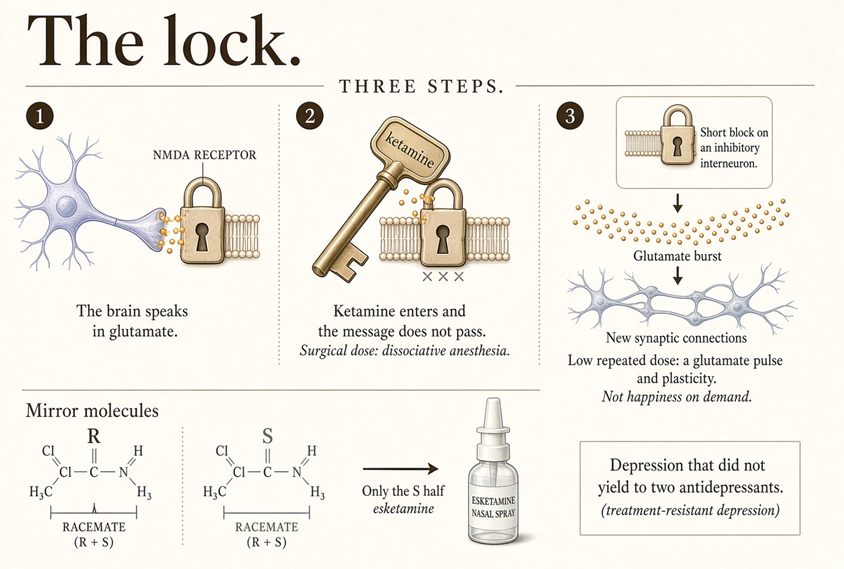
Musk described a state. He did not describe the lock. In the book A sociedade da birra (The Society of the Tantrum) the lock was already drawn, long before the animal-facility vial, and without any billionaire’s name.
The brain is not a mood. It is an exchange of messages. The message that switches a cell on is called glutamate. The lock that receives that message is called the NMDA receptor. When the lock opens, the cell fires. When it sticks, the message does not pass. Ketamine is the key that enters and sticks. At a surgical dose, the person, or the animal, dissociates: the body does not answer as usual, and breathing as a rule continues. That is anesthesia, not sleep.
At a low dose, repeated, the account changes, and the book already separated the two. The block is short and falls on a small cell, the interneuron, which had been holding the message back. When it lets go, a pulse of glutamate comes out. That pulse helps the synapse rebuild. Plasticity is the technical name. In plain language, it is the link between two cells gaining a new path. It is not pharmacy happiness. It is not “happy on the spot.” It is the same lock, at another dose, in a window of minutes. The trial measures that on a depression scale. The book warned that mixing the two accounts, surgery and mood, produces a soap opera.
The molecule sold as ketamine is a mixture of two mirror halves, R and S. Esketamine is only the S. That is the half that became a spray: 56 or 84 milligrams, inside a clinic, with two hours of observation. The patient does not take the vial home. The “small amount, every other week” Musk declared fits that order of magnitude. It fits the testimony. It does not fit the tender.
What A sociedade da birra did not have was the quotation: five liters, 140 vials, 500 grams, 16,666 applications of 30 milligrams, and no consumption ledger. The lock explains the effect he described. It does not explain where the liter went.
The depression that did not yield
Treatment-resistant depression, in the American registration, is major depression that has not responded to at least two antidepressants in the current episode. The spray is called Spravato. The FDA approved it on 5 March 2019, together with an oral antidepressant. In 2020 it extended the label to depressive symptoms with acute suicidal ideation, also with an oral drug. On 21 January 2025 it approved use alone, in adults, as the first monotherapy of this kind.
Each device delivers 28 milligrams. The induction dose is 56 or 84 milligrams, twice a week, for four weeks. Then once a week or every two weeks. The patient does not take the vial home. They use it in the clinic, under supervision, and stay two hours for observation. The program is called REMS. It exists because of sedation, dissociation, and the risk of diversion. Blood pressure is measured before and after. It is not a drawer pill.
The phase 4 trial, led by Adam Janik and published in JAMA Psychiatry, compared 56 mg and 84 mg with placebo, alone, for four weeks. On day 28 the difference on the MADRS scale was −5.1 points with 56 mg and −6.8 with 84 mg. The effect showed in the first 24 hours. A classic oral antidepressant takes weeks. That is the argument. It is not a published cure. It is a difference on a scale, in a trial, against placebo.
The clinic price in Brazil is not in this piece. It varies by service and did not come out of a single tender. What is in the piece is the dose: tens of milligrams, in a device, inside a room. Not a liter.
The nickname
Special K is the street name of the same substance. The name does not change the molecule. It changes the vial, and the absence of a ledger. The United Nations treats it as a market, not a curiosity. The 2026 World Drug Report says seizures rose until 2022, eased a little in 2023 and 2024, and that 83 percent of what was seized worldwide between 2020 and 2024 was in East and Southeast Asia. In 2023, in that region alone, the figure was 23.3 tonnes. Europe accounted for 7 percent of the period. The Americas, 5 percent.
Brazil, in the Federal Police series cited by the newspaper O Sul on 9 June 2024, is another size. The Federal Police began tabulating the substance in 2021: 4 seizures, 698 grams. In 2022, 10 cases, 2,514 grams. In 2023, 22 cases, 4,463 grams, up 78 percent. Seventeen of the 22 were in São Paulo. The official Brazilian number is grams, not tonnes.
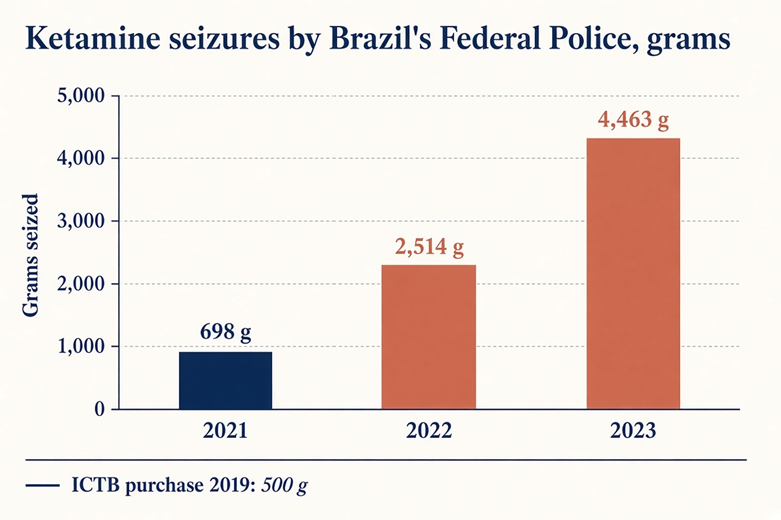
This text does not describe street price, cutting, drying, or how to inhale. That would be unethical. It is not label data and it does not help read the tender. The comparison that holds is of mass. The portion that circulates outside the hospital, in public-health reports, is also tens to a few hundred milligrams. The public purchase is in liters.
The 30-milligram sum
The purchase that closes the number is Electronic Quotation no. 45/2019 of the Institute of Science and Technology in Biomodels, the Fiocruz animal facility in Manguinhos, Rio de Janeiro. Object: emergency purchase of a veterinary anesthetic. Opened on 6 September 2019. Report on Comprasnet, code 363769.
Two items are ketamine at 100 milligrams per milliliter. Item 1: 50 vials of 10 milliliters. That is half a liter. Lowest bid, R$ 941.39. Item 3: 90 vials of 50 milliliters. That is 4.5 liters. Reference price, R$ 10,930.50. Lowest bid, R$ 9,628.99. Supplier of both: E. R. Felix Produtos Agrop. Sum: 5 liters. Together, 140 vials.
Five liters at 100 milligrams per milliliter are 500,000 milligrams. Five hundred thousand milligrams are 500 grams. Both sentences are the same mass. A 30-milligram restraint uses milligrams, not grams. 500,000 divided by 30 is 16,666 applications. If the dose is doubled, 60 milligrams, it is still 8,333. If halved, 15 milligrams, it is 33,333. The sum does not say the applications were made. It says how many fit in the vial.
Human surgical induction, published range of 1 to 2 milligrams per kilogram in the vein. A 70-kilogram adult, 1.5 mg/kg: 105 milligrams. Five hundred thousand divided by 105 is about 4,761 inductions. A large operating block does dozens of anesthesias a day, and ketamine is not the induction agent for all of them. It is an option. Five liters, in one purchase, cover years of a block, or an animal house that restrains a monkey every day and still has some left.
| From 500,000 mg | Dose used | How many fit |
| Monkey restraint, 3 kg (estimated weight for calculation) | 30 mg | 16,666 |
| Same, double dose | 60 mg | 8,333 |
| Human induction, 70 kg | 105 mg | 4,761 |
| Esketamine session, mass only | 84 mg | 5,952 |
| Federal Police, 2023 | 4,463 g | the purchase is 11% |
Arithmetic of the tender. Not proven consumption.
The size of the others
Five hundred grams are about 11 percent of everything the Federal Police seized in the whole of Brazil in 2023. One quotation, from one institute, called an emergency. It is not a map of trafficking. It is the scale.
A comparison that is in a tender, not a guess. In January 2026 the Guarulhos health department published a direct purchase for 60 vials of 10 milliliters of ketamine hydrochloride at 10 percent, plus thiopental and xylazine. Sixty vials are 0.6 liter. The ICTB quotation, six years earlier, asked for 5 liters. Eight times the volume of a whole city health department, in an institute that is not a trauma hospital.
The same quotation 45/2019 carries what an animal house uses alongside: 10 vials of tiletamine with zolazepam, 119 of xylazine 2 percent, 48 of acepromazine. The set is veterinary anesthesia. What is missing is the ledger. How many primates there were. How many restraints. How much expired. How much was incinerated.
The purchase does not pass through the Federal Police the way a stamp passes over a bid. It passes through Anvisa, and the ledger is what the Federal Police reads if the account does not close. Ketamine is a specially controlled substance under Ministry of Health ordinance 344/1998. In 2019, the year of the quotation, it was on list C1. Collegiate board resolution 676, of 28 April 2022, took ketamine off C1 and put it on B1, the psychotropic list, together with esketamine. The label then had to carry, in highlight, “use restricted to health establishments.” Whoever buys, stores, and applies needs an operating authorization and a special authorization from Anvisa, plus bookkeeping and a balance. It is not a glove purchase. The tender does not replace the in-and-out book.
What is not asserted
This report does not assert trafficking. It asserts a published purchase and an unpublished consumption. The use report, the intake, the outflow, and the remainder were requested under the Access to Information Act. When the answer comes, the number stops being a sum and becomes a ledger. Until then, 5 liters are 500 grams, 16,666 restraints of 30 milligrams, and 11 percent of one year’s federal seizure.
The nickname Special K does not turn the vial into proof. The missing report is what keeps the sentence open. Whoever has the ICTB consumption ledger closes the account. Without the ledger, the sentence that holds is this: the purchase is in liters, the use is in milligrams, and the report is not on the portal.
References
- CNN Business, Clare Duffy, 18 March 2024. Don Lemon interview with Elon Musk.
- Braga, Isabel. A sociedade da birra. Rio de Janeiro: author edition, 2025. ISBN 978-65-01-03962-6.
- FDA. Spravato approval, 5 March 2019. Monotherapy, 21 January 2025. DailyMed, 28 mg device, 56 or 84 mg dose.
- Janik and colleagues, JAMA Psychiatry, phase 4. MADRS difference on day 28: −5.1 (56 mg) and −6.8 (84 mg).
- UNODC, World Drug Report 2026. August 2024 note: 23.3 tonnes in East and Southeast Asia in 2023.
- Federal Police series 2021–2023, cited by O Sul, 9 June 2024: 698 g, 2,514 g, 4,463 g.
- Comprasnet, Electronic Quotation 45/2019, ICTB, report 363769. Guarulhos notice 97001/2026, 60 vials of 10 mL.
- Anvisa RDC 676/2022: ketamine moved from list C1 to list B1 of ordinance 344/1998.

 Português do Brasil