



Isabel de Fátima Alvim Braga

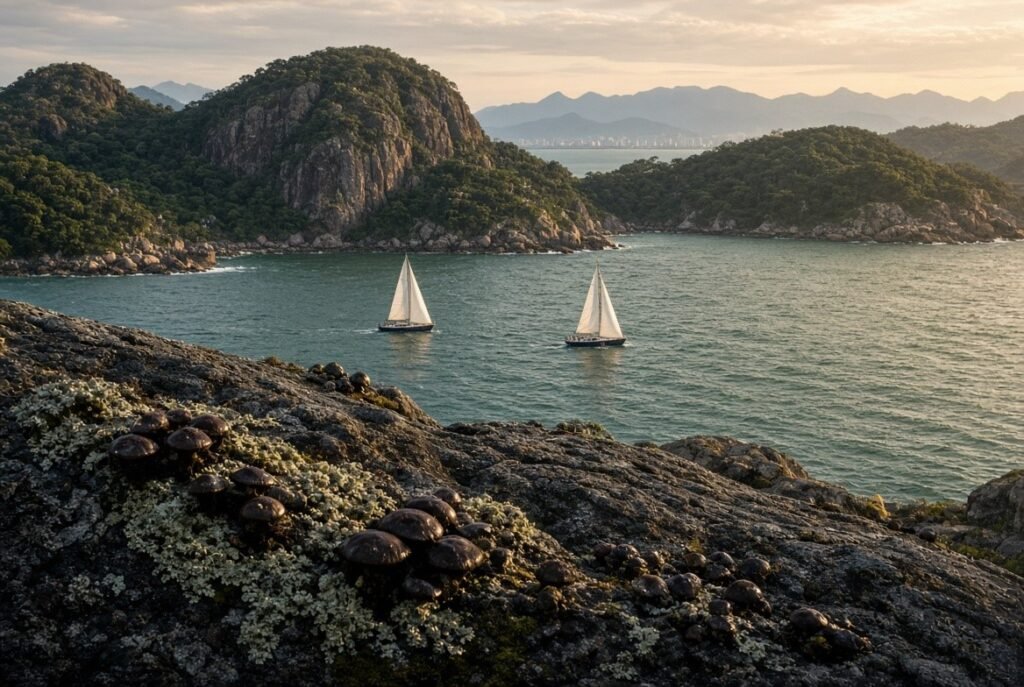
Rio de Janeiro has nuclear a plant that leaks. That is documented. It is not a slogan: it is the file we published in Pàhnorama — “The nuclear plant leaks: the litre, the silence and the partner” ( Read here: https://revistapahnorama.com.br/2026/08/29/the-nuclear-plant-leaks-the-liter-the-silence-and-the-partner/ )
In September 2022, water with low radioactive content left Angra 1 through a corroded valve, reached the slab, the storm drain and Itaorna Bay. Estimated volume: about 90 litres. The Federal Court measured 21 days of delay in the notice. Ibama fined the company. Eletronuclear admitted a communication failure. In February 2025 the company described another occurrence, at Angra 2: passage through the first seal of the lid, less than a litre a day, collected in the design tank; according to the note, the second seal intact, no Limiting Condition for Operation open, the plant at 100 percent. The federal audit court, in the same governance setting, weighed billions in no-bid contracting. None of those sentences authorizes evacuating Paraty. All of them authorize an adult question: what is done with the coast when the paperwork and the sea do not match.
Condemning the Marvelous City and the bay where the Olympic champion has always sailed is a crude error. Marina da Glória and the 2016 courses sit in Guanabara Bay. Itaorna sits in Ilha Grande Bay. They are different waters. They are the same state. And São Paulo’s waters are next door, where Ilhabela Sailing Week takes place. Anyone who loves sailing, the fish, the hotel in Abraão and a late afternoon in Leblon lives on the same map. Thinking about a solution — and not only attack and Orwellian silencing — makes more sense than pretending the atom chooses a party.
No political affinity survives the information of a nuclear leak on the Brazilian Caribbean: everyone is hit. The militia that charges for cooking gas at the mouth of the hill and the militia that dines in Leblon discover, in the isotope, the only equality the coast has not yet privatized. Looking at the solution is looking at what the state should have been before partisan political militia joined to pull from the race anyone who still had an honest chance of competing with those already at the table.
The current that would carry the rest is not the polar current. The Brazil Current is born from the split of the South Equatorial Current and runs southwest, warm, tight to the shelf. In Ilha Grande Bay the first destination is local: residual circulation in the channel, shelf water that enters and leaves, mixed with the fresher tongue that comes from Sepetiba. From there, shelf transport follows the Costa Verde — Paraty, the northern coast of São Paulo, Santos, Cananéia.
Much farther south, around 36–38°S, that warm water meets the Malvinas Current, a cold arm that rises from the Antarctic Circumpolar. Only there, at the Brazil–Malvinas Confluence, whatever residue remains in the column actually mixes with water of polar origin.
Anyone who says “polar current at Angra” skips three scales. Anyone who says “it goes nowhere” ignores the shelf.
The solution interests everyone. That is why this text does not ask for the Pripyat fungus on Itaorna concrete. It asks for the mechanism — and the heat Rio already has.
What Fukushima taught — and what Chernobyl mixed
After 2011 Japan did not discover a being that “drank rays.” It discovered what mycelium already does with potassium: it treats caesium-137 as a chemical cousin. Wild mushrooms and lichens pull the ion from soil and litter and store it in tissue. Thirteen years later there were still lots above 100 Bq/kg. In dozens of Fukushima municipalities the shipping of wild mushrooms remained restricted. That moves people because it is intimate: the forest plate became an inventory. It does not move people because it cleans the territory. It concentrates. Whoever harvests and discards as waste removes a fraction. Whoever eats takes the dose.
In the lichen Parmotrema tinctorum, two and six years after the accident, the caesium sat in the brown parts of the lower cortex — melanin-like substances. Chemistry says those groups chelate Cs⁺: they trap the ion in the pigment. It is not gamma photosynthesis. It is a molecular clamp.
Chernobyl added another scene, more cinematic and less closed. Black fungi grew on the walls of reactor 4. Cladosporium sphaerospermum, Exophiala (Wangiella) dermatitidis, Cryptococcus neoformans. Hyphae sometimes walk toward the source — radiotropism. Melanized strains, in the laboratory, grew better under dose than albino ones when nutrients were scarce (Dadachova, Casadevall, 2007). The press translated: they eat radiation. The paper translates: melanin changes when radiation passes.
Melanin, without cheap poetry
Chernobyl fungal melanin is mostly DHN — 1,8-dihydroxynaphthalene — made on the polyketide pathway, a PKS1-type gene. It is not the pigment of human skin (tyrosine eumelanin), though both are dark polymers of aromatic rings.
Three functions the literature supports. First, a physical shield: layers in the wall, on the order of 100 nm stacked, attenuate part of the dose. Estimates of fungal-melanin shielding sit in the neighbourhood of “half of lead, twice carbon” — an order of magnitude, not sarcophagus engineering. Second, a chemical shield: the molecule donates an electron and holds a radical; the cell dies less from oxidative stress. Third, electronic transduction: ionizing radiation alters the state of melanin and increases its ability to transfer electrons in model reactions. Hence the radiosynthesis hypothesis: an antenna in place of chlorophyll.
What is not demonstrated: carbon fixation driven by gamma rays; ATP accounted as coming from the reactor photon; a biological plant that zeroes an inventory. Later papers show pigment that changes and growth that does not always rise. The culture may only be spending less energy on repair because the black wall already took the hit.
That is why the honest sentence is narrow and enough: melanin does not eat the nucleus. It holds the ion and spreads the energy so the fungus does not die as fast. The caesium nucleus keeps decaying inside the cap. Half-life remains thirty years. The pigment is a warehouse and a damper. It is not a vacuum cleaner.
Rio is not Pripyat. The pigment is.
Cladosporium sphaerospermum is cosmopolitan — bathroom, leaf, salt pan, the tropics included. The sarcophagus strain was selected by decades of dose. The one on a Carioca tile was not. And that classic species stalls near 35–37 °C. On hot summer granite, other blacks take over.
What the heat of the State of Rio already grows, with the same class of melanin: Cladosporium of wall and litter; Aspergillus niger, a melanized spore, ubiquitous, resistant to UV and X-rays; Hortaea werneckii, a black yeast of coast and salt — the shoreline makes sense; Exophiala dermatitidis, the same genus as the 2007 papers, thermotolerant, a gamma D10 in the thousands of gray — and a pathogen; Fonsecaea pedrosoi, DHN, soil and plant, chromoblastomycosis of the Brazilian rural worker.
Fonsecaea is not planted at Itaorna “to clean Angra.” The melanin that shields the fungus from gamma rays is the melanin that shields it from the immune system in a leg. A solution is not releasing disease.
If the state wanted research — not liturgy — the protocol would fit on one page: isolate the black already on the site; measure melanin and survival under dose; exclude pathogens; treat biomass as waste, not as fertilizer. The mould mat, in the best case, is a film that attenuates and a clamp for caesium, like the Fukushima lichen. In the worst case, it is the forest plate becoming an inventory, like the mushroom Japan still restricts.
What sailing teaches the atom
Martine Grael and Kahena Kunze took the 2016 gold in Guanabara Bay. Torben has sailed that water his whole life. No one sails the Itaorna storm drain. Everyone sails in the same country that waited 21 days to say that 90 litres had gone to sea. The shame is not the bay. The shame is the silence that treats the coast as if it belonged to a table. Looking at the black fungus on hot granite is not surrender to the reactor. It is refusing the only programme the state has offered so far: attack whoever asks and call that safety. The current runs south. The melanin is already on the wall. The rest is a decision — and a decision, on this coast, still has no party that can contain it
Isabel de Fátima Alvim Braga
Note. This English version follows the published Portuguese text. A few closing sentences that the page extractor cut short were completed from the same article’s argument (melanin as warehouse, not vacuum; local strain, not Pripyat import). Figures and leak dates match the published file and the earlier Angra dossier.


