



Braga, Isabel MD. phD.

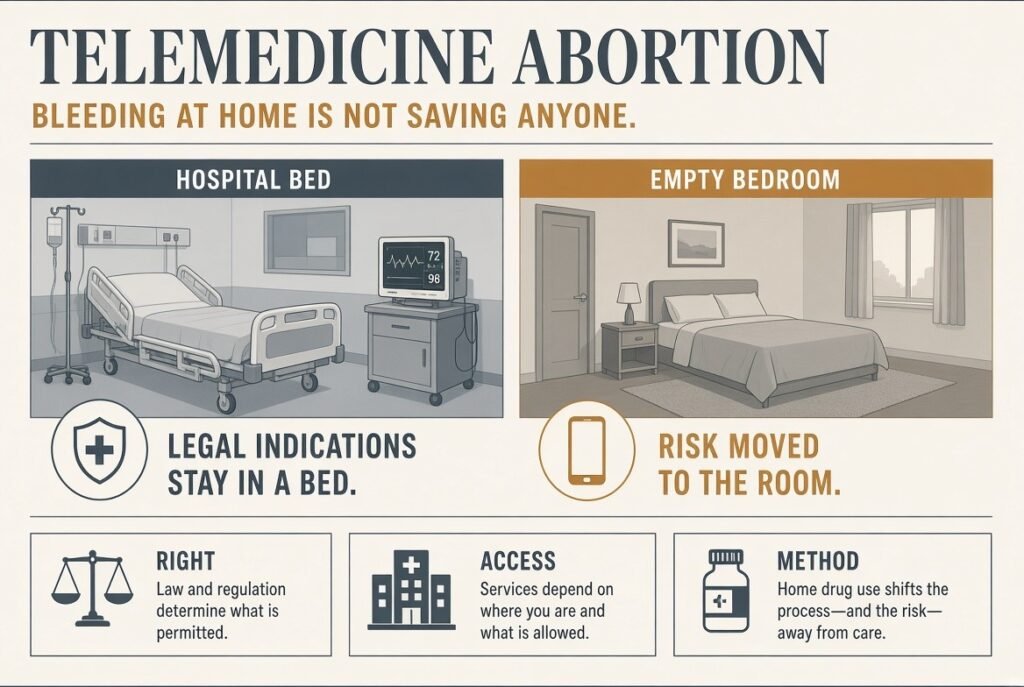
The risk leaves the bed and goes to the bedroom. The handbook calls that care.
There is, in fact, material produced around the Hospital de Clínicas of the Federal University of Uberlândia. The handbook Legal abortion via telehealth: guidance for health services (2021) came out with the stamp of Nuavidas/HC-UFU, Anis – Instituto de Bioética and Rede Médica Pelo Direito de Decidir. There is also the later care protocol of HC/UFU itself. The pioneer service, under gynaecologist Helena Paro, was born in the pandemic: to receive victims of sexual violence and offer the interruption provided by law without occupying a bed at the peak of Covid. The pandemic is over. Does the handbook remain valid?
The larger problem in the text is not the phrase “legal abortion.” In Brazil it exists in three hypotheses — rape, risk to the life of the pregnant woman, anencephaly. The problem is the next leap: treating home, telephone and isolated misoprostol as if they were the natural, compassionate and scientifically obvious way to exercise that right.
The handbook calls that protecting girls and women. What it organises, in practice, is something else: the moment the uterus bleeds leaves the hospital and goes to the bedroom.
Three things the manual glues together as if they were one
The “save women” argument only works if the reader accepts a package: the right (already provided in the Penal Code); access (few services, stigma, pandemic); and the method (drug at home, remote triage). To refuse the third looks like refusing the first. That is a political shortcut, not a clinical argument.
Teleconsultation was authorised in the health emergency (Law 13.989/2020 and 2020 ordinances). That does not rewrite SVS/MS Ordinance 344/1998, which reserves misoprostol to an accredited hospital, nor turn a house into a legal-abortion unit. The Ministry of Health, in Technical Note 28/2021, positioned itself against legal abortion via telehealth and cited this handbook. The Federal Council of Medicine was explicit: opposed to the procedure by telemedicine outside the hospital setting.
What Nuavidas in fact did at the beginning was hybrid: first assessment in hospital, the medicine handed over there, follow-up later. The handbook goes further and recommends remote admission and home dispatch. It mixes what a public service tested with what an NGO wants the SUS to copy.
“Bleeding at home — how so?”
Because abortion with misoprostol is not a silent erasure of pregnancy. The effect sought is contraction and expulsion. Bleeding and cramp are not an embarrassing side effect: they are the mechanism. The handbook teaches the patient to treat the picture as “heavy menstruation,” reserves hospital for what it classifies as worrying, and admits, in its own terms, haemorrhage as an uncommon event.
Ethical translation: the institution keeps the prescription and the success statistic; the woman keeps the towel and the question “is this still normal?” In a rape victim — the pilot’s target public — the asymmetry is even thicker. Whoever is least able to refuse becomes the body of proof in a regulatory controversy.
If the hospital was too dangerous in Covid, the bedroom does not automatically become safe. Haemorrhage does not wait for WhatsApp. Incomplete abortion is not solved with an illustrated card. Ectopic pregnancy does not announce itself by a risk factor on the form. The handbook relativises ultrasound when there are no “classic signs” of ectopic pregnancy. Ectopic pregnancy does not need a classic history.
To call that care is to shift the risk and rename it.
The drug Brazil already knows from the other side
In Brazilian legal service the regimen is misoprostol alone. The combination WHO treats as standard — mifepristone plus misoprostol — is not on the registered roll here. Isolated misoprostol is the international plan B, not the gold standard. Recent reviews estimate overall failure in the region of 11% to 15% and ongoing pregnancy around 3% to 10%. The handbook itself works with efficacy of 75% to 90%. Two digits of a plan that does not close remain.
Failure is not a dead number. They are destinations: the uterus bleeds and does not empty; the pregnancy continues, after the embryo has taken the contraction; the patient does not come back — the weakest link in any remote model. The second destination is the one humanitarian discourse avoids naming.
What the press documents when the abortion is at home
There is, in the press consulted, no report of a death attributed to the Nuavidas/HC-UFU protocol. To assert the contrary would be to invent. What exists, and is published with name, city and date, is another series: young women who aborted at home, with a drug or a “kit,” and died.
In October 2021, Ana Carolina Pereira Pinto, 20, was found dead by her parents in the house where she lived, in Votorantim (SP). According to G1, the investigation indicated that two days earlier she had used medication to abort in a guesthouse in Sorocaba, at seven months of pregnancy. The boyfriend was charged by the Public Prosecutor with abortion and femicide; pre-trial detention was later revoked, with precautionary measures.
In February 2018, Caroline Mele Machado Duo, 23, was found dead in a bedsitter in Itapema (SC). Portal Catarinas, based on the police record, reported suspected pregnancy of about six and a half months; at the scene there were Cytotec tablets, a surgical glove and other objects. SAMU could not resuscitate her.
In Petrópolis (RJ), in 2018, G1 reported the death of Ingriane Barbosa, 30, four months pregnant, after an abortion at home. She spent seven days in hospital and died of generalised infection; the report cited bacterial endometritis and abortion.
In Chapecó (SC), Civil Police investigated the death, in September 2024, of a 35-year-old woman, mother of four, 12 weeks pregnant. The delegate said the elements indicated illegally imported misoprostol and that the victim died of generalised infection after complications of induced abortion; she had sought medical care after the procedure.
None of these cases is the UFU service. The nexus that can be asserted without fraud is another: a house is not a bed. When bleeding, infection or delay in help happen far from hospital, the outcome the press records is not “heavy menstruation.” It is death.
The handbook describes home bleeding as expected and hospital as additional risk. The same group defends safe birth and evidence-based medicine. The cases above show the reverse of that sentence — without inventing a Nuavidas patient.
When Cytotec “fails”
The teratogenicity of misoprostol is not WhatsApp folklore. The classic literature is Brazilian. In the 1990s, when Cytotec still circulated in pharmacies and was used off-label to abort, geneticists described a pattern: Möbius sequence (congenital paralysis of the face and eye movements), transverse limb defects, hydrocephalus, arthrogryposis, constriction rings. Pastuszak’s study in the New England Journal of Medicine (1998) found an odds ratio near 30 for Möbius after an abortion attempt with misoprostol. Later meta-analyses repeat the order of magnitude: enormous relative risk for Möbius and for limb reduction; general risk of anomaly also raised.
The proposed mechanism is not mutation. It is vascular disruption: the contraction that should expel the embryo, if it fails, can ischaemise cranial-nerve nuclei and arm and leg buds. The embryo survives the attempt. The child is born with a still face or an interrupted limb.
Absolute risk of Möbius remains low — the syndrome is rare. Relative risk explodes in the only scenario the home manual multiplies: a pregnancy that did not end and was not confirmed in time. The European gastrointestinal misoprostol label and Anvisa warnings say the same in regulatory language: if gestation continues after exposure, watch the fetus, especially the limbs.
Clandestine Cytotec and the hospital product are the same active ingredient. Biology does not change because a medical council signed. What changes is only the chance that someone notices plan A failed.
Who pays for the stamp of “care”
The handbook was not born only in the Hospital de Clínicas corridor. In the PDF credit line is written the funding of IPPF/RHO — the Americas arm of the International Planned Parenthood Federation. Nuavidas lends the clinical name. Anis and Rede Médica Pelo Direito de Decidir sign the piece. The money for the publication, in the footer itself, is not university treasure.
Anis – Instituto de Bioética, Direitos Humanos e Gênero (CNPJ 03.225.652/0001-12) is a private association in Brasília, opened in 1999. On the Transparency Portal it appears as a beneficiary of Union resources; the accumulated figure on the record reaches about R$1.93 million. Older covenants, added by the press for 2005–2014, passed R$5 million in projects under other names — violence against women, “family planning,” socio-educational. The covenant title almost never says “abortion.” The organisation that signs the telehealth handbook is the same that captured those budget lines.
There are also Open Society Foundations grants. A public compilation points to five transfers to Anis between 2016 and 2023, of the order of US$775,000. The foundation declares the grant on its site; conversion into reais moves with the exchange rate. That is not a statement of the handbook’s account. It is the same institutional address receiving, over the years, money whose declared purpose includes abortion advocacy and gender agendas.
None of that proves misoprostol “does not work.” It proves something else, which the manual hides under the word care: the design of bleeding at home is not only a protocol of a Minas Gerais university hospital. It is a product of a political-advocacy NGO with international fundraising, a public-service stamp and a text that teaches the SUS to copy the model. Whoever disagrees with the method becomes, in the discourse, an enemy of the right. Whoever asks where the grant came from becomes inconvenient.
UFU can — and should — say whether the handbook is the rectorate’s position or only a nucleus’s. Anis can — and should — publish the exact IPPF funding figure for the 2021 edition and the accounts of the following years. Until that comes, the reader is left with what is already printed: legal abortion in the bedroom, a statistic of “heavy menstruation” in the hospital, and the handbook’s bill in another jurisdiction.
The incoherence, in one sentence
One does not protect a woman by sending to the bedroom the only interval in which she can exsanguinate. One does not invoke the vulnerable child in rights discourse and fall silent before the child who may be born with Möbius because follow-up was a pharmacy test four weeks later. And one does not call “just telehealth” the act of dispensing a hospital-use medicine for self-administration.
The right to legal abortion remains. The scarcity of services is real. The pandemic was real. None of those sentences authorises a university hospital and an NGO to redesign the site of risk against the reading of the Ministry of Health and the medical council, and still sell the design as compassion.
Whoever writes about this has a simple duty: to separate what the law already allows from what the handbook wants to normalise. Blood at home is not a metaphor. It is the procedure. Treating the two as a synonym of salvation is the handbook’s first error — and what an article must not repeat.
Isabel Braga — Quotations from the handbook were transcribed from the official PDF (Anis, 2021). This article does not reproduce dose schemes, routes or administration intervals.
References
1. Anis; Global Doctors for Choice Brasil; Nuavidas/HC-UFU. Aborto legal via telessaúde: orientações para serviços de saúde. Brasília: LetrasLivres, 2021.
2. Basso DAA. Aborto legal: protocolo assistencial do HC-UFU. Master’s dissertation, UFU, 2024.
3. Brazil. SVS/MS Ordinance 344 of 12 May 1998. Special-control medicines.
3a. Brazil. Law 13.989 of 15 April 2020. Telemedicine during Covid.
3b. Brazil. Ministry of Health Ordinance 467 of 20 March 2020.
3c. Brazil. GM/MS Ordinance 2.561 of 23 September 2020. Legal interruption of pregnancy in the SUS.
4. Ministry of Health. Technical Note 28/2021-DAPES. Incompatibility of telemedicine with legal abortion procedures.
5. Federal Council of Medicine. Official letter 1.593/2021-CFM/COJUR. Opposed to legal abortion by telemedicine outside hospital.
6. Federal Public Prosecutor. PFDC Technical Note 5/2021. NUAVIDAS HC/UFU protocol.
7. Raymond EG, Harrison MS, Weaver MA. Contraception, 2023. Misoprostol-only first-trimester medication abortion review.
8. Gonzalez CH et al. Lancet 1998. Congenital abnormalities associated with misoprostol misuse.
9. Pastuszak AL et al. N Engl J Med 1998. Misoprostol and Möbius syndrome.
10. Dal Pizzol TS et al. Reproductive Toxicology 2006. Prenatal misoprostol and anomalies.
11. Arch Gynecol Obstet 2024. Teratogenicity after continued pregnancy following mifepristone and/or misoprostol.
12. WHO. Safe abortion: technical and policy guidance. 2nd ed. 2013.
13. Ministry of Health. Prevention and treatment of harm from sexual violence. 3rd ed. 2011.
14. EMA/CMDh. Scientific conclusions — gastrointestinal misoprostol: teratogenicity and Möbius sequence. PSUSA/00010291/201706.
15. WHO. Medical management of abortion. Geneva, 2018.
16. Nunes J. G1 Sorocaba, 5 Oct. 2022. Ana Carolina Pereira Pinto, Votorantim/SP.
17. Portal Catarinas, 23 Feb. 2018. Caroline Mele Machado Duo, Itapema/SC.
18. Rickly A, Soares F. G1 Região Serrana, 20 July 2018. Ingriane Barbosa, Petrópolis/RJ.
19. ND Mais, Chapecó, 28 Feb. 2025. 35-year-old woman, Sept. 2024; investigation cites misoprostol.


