



Isabel de Fátima Alvim Braga, MD phD

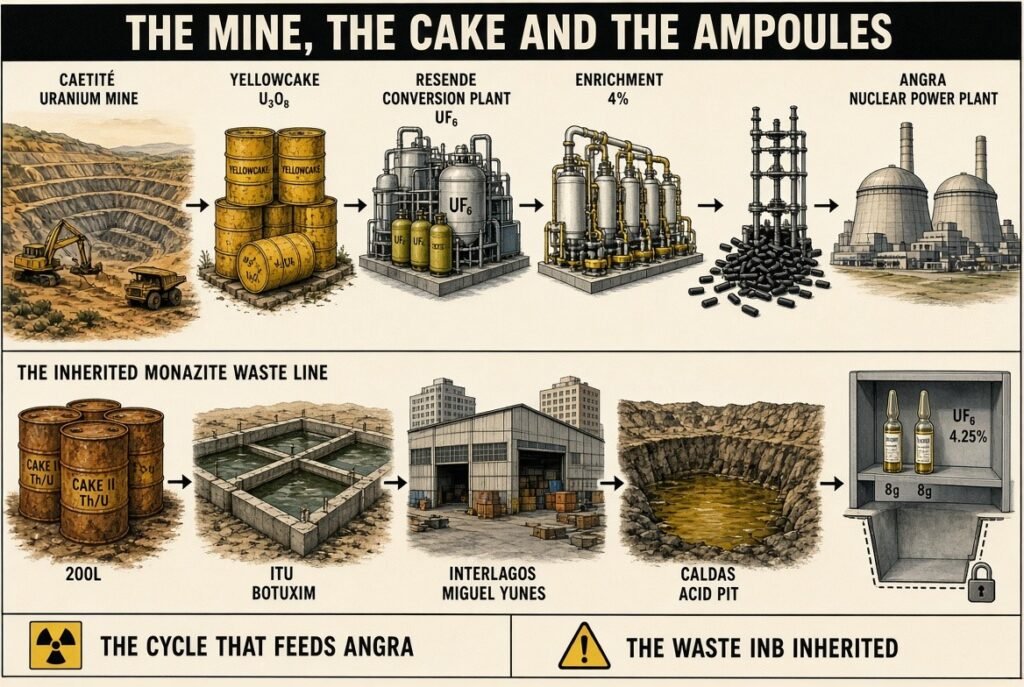
Eletronuclear is the plant: it splits the atom and makes light. INB is everything that comes before: it digs the ore, takes the yellow powder, turns it into gas, enriches it, makes the pellet and delivers the assembly to Angra. Without INB, Angra 1 and 2 are a building with no firewood. With INB, Brazil says it holds the cycle — from the ground to the pellet — in the hands of the State.
What does not fit in the brochure is the rest of the family: Orquima in Brooklin in the 1940s, Nuclemon, the Santo Amaro plant, the Cake II drums in Itu and Interlagos, the acid pit at Caldas, the Caetité uniform washed at the worker’s house, and two finger-sized ampoules — 8 grams of uranium gas at 4.25% — that the CNEN inspector did not find on the shelf in July 2023. [1]
The TCU, in the same survey that weighed Eletronuclear, looked at INB. Sole-source contracting: 22.5% of amounts spent. Failures in calling bidders in the internal audit. The same Ruling 671/2026 that stamped R$5.3 billion of “there is only one supplier” at the plant stamped the profile of the fuel factory. [2] The sentence that fitted Angra fits here, with another CNPJ: the cycle company also buys in the dark enough for the monazite liability and Bahia yellowcake to slip the auction.
1. What INB is — and what Nuclemon was
Nuclebrás is born in 1974, Law 6.189, Brazil–Germany Agreement, to have the whole cycle. Decree-Law 2.464/1988 recasts the programme and renames the company Indústrias Nucleares do Brasil. In 1994 INB swallows the subsidiaries: Nuclei (enrichment), Urânio do Brasil and Nuclemon Mínero-Química Ltda. [3] Whoever processed monazite in Santo Amaro did not vanish. It changed the plate.
The timeline a lay reader needs: Orquima (1940s–50s, Santo Amaro, monazite from sands of Rio, Espírito Santo and Bahia; the business was thorium for gas-mantles and rare earths; uranium at 0.3% was a by-product). Routing through CNEN: Monazite Production Administration, then CBTN, then Nuclemon under Nuclebrás (1974–1994), Santo Amaro Plant (USAM) and the Interlagos depot. In 1992 the plant stops. Decommissioning declared complete in 1998. INB inherits the waste, the process and the labour suits.
The residue has a kitchen name and a depot dose. Cake II: residual of the alkaline attack and hydrochloric dissolution of monazite, rich in thorium and uranium. Mesothorium: the fraction rich in radium-228. From 1975 to 1981 Cake II went to a Nuclebrás site at Botuxim, Itu. Later part went to the Caldas Complex. In Itu there are still about 3,500 tonnes.
In 2024–2026 INB tried to sell Cake II from Itu, São Paulo and Caldas; the call was postponed six times and died with no bid in March 2026. In 2013 a Chinese contract of R$65 million did not take the material out of the country: China did not license entry. [4]
The São Paulo City Council inquiry, in the 1990s, concluded: contaminated soil at the Interlagos plant; Nuclemon responsible for failing area control; CNEN omitted in oversight; storage at USAM was a risk to worker and neighbour. Nuclemon’s own internal report: 59 workers above the public dose limit in 1987. DRT, Fundacentro, the Chemical Workers’ Union and the Labour Prosecution Service closed the plant’s cycle.
ANTPEN and lawyer Luiz Carlos Moro still work with survivors. The TST, in 2026, upheld a late-disease damages action. Medical account cited in the press: of a group of 65 under follow-up, one third had cancer.
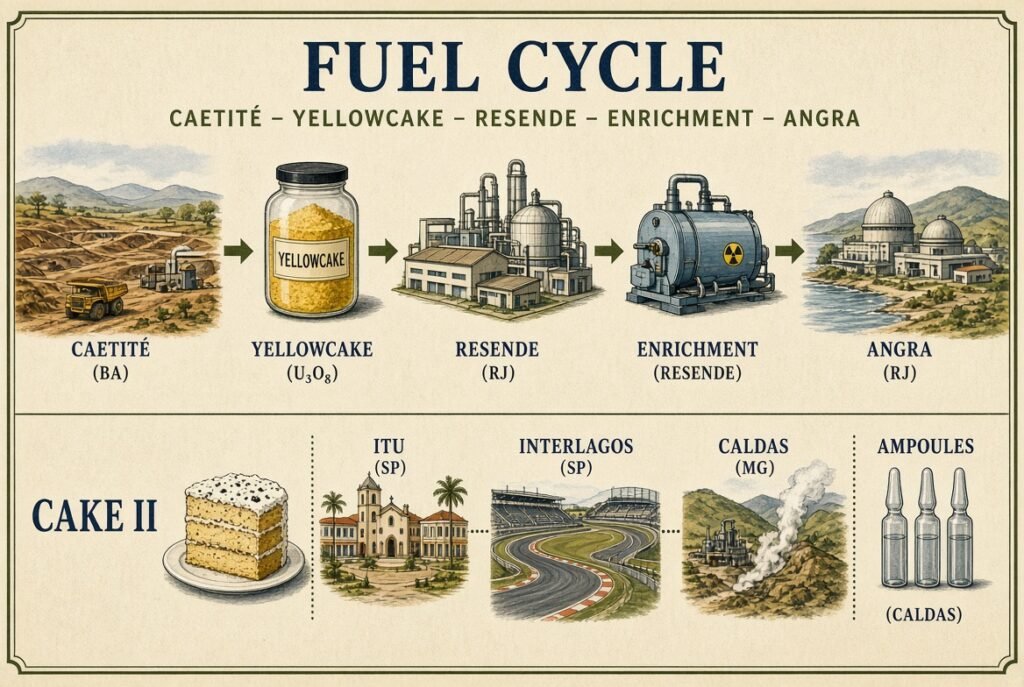
Figure. Above, the cycle that feeds Angra. Below, the monazite line INB inherited from Nuclemon and has still not sold.
2. How the water — and the gas — move (for a lay reader)
Think of a long bakery. Caetité is the wheat. Resende is the oven. Angra is who eats the bread. Without the wheat, the oven does not bake. Without the bread, the plant does not turn.
In Caetité, in south-west Bahia, INB digs uranium ore in an open pit — a large hole, not a tunnel. Since 1999. The ore does not go raw to Angra. First it is mixed with acid and solvent. What remains, yellow, is yellowcake: a uranium-oxide powder/paste (U₃O₈), the “yellow cake” of world trade. From 2000 to 2015 the Cachoeira mine gave 3,750 tonnes of that concentrate. Today the Engenho mine operates.
Brazilian yellowcake, for much of recent history, still travels to Europe to become gas — conversion. In Resende INB also converts and enriches. Conversion: the oxide becomes uranium hexafluoride, UF₆. At room temperature UF₆ may be solid or gas depending on pressure; in the plant it is treated as gas. If it leaks and meets water vapour in the air, it becomes hydrofluoric acid (HF): it burns skin and lung. It is not the Chernobyl cloud. It is fluorine chemistry.
To enrich is to separate. Natural uranium has only 0.7% of the isotope that splits easily (U-235). The rest is U-238, too heavy for Angra’s reactor. The ultracentrifuge spins the gas and U-235, a little lighter, rises in the mix. Brazil has tested this since 1982 and is one of the few countries that does it. Angra fuel leaves at about 4% U-235. A bomb wants tens of percent and another design. The ampoules that went missing in 2023 held 4.25% — plant grade, 8 grams each. Dangerous as inventory and as fluorine. Useless as a warhead.
Then the gas returns to powder (UO₂), the powder becomes a black pellet the size of a pen cap, the pellet goes into a zirconium-alloy tube, the tubes become an assembly — the fuel element. The truck takes the assembly to Angra. Only there does the uranium split and heat the primary water the other article described.
Three geographies, three ways to go wrong. Caetité: dust in the lung, liquor (the liquid that carries uranium) and solvent that, if rain hits, go to drainage and the creek. Resende: UF₆ gas and the gram-by-gram account international safeguards require. Caldas: the old uranium mine, closed, with acid water in the pit and a dam. Itu and Interlagos: a monazite leftover shed in the middle of people. It is not Angra 2’s head seal. It is the start of the chain the plant presents as if it began with a finished pellet.
3. Leaks and omissions — the list the press and the labour prosecutors documented
April 2000, Caetité, start of the mine. Five million litres of uranium liquor were said to have overflowed the settling ponds. Bahia’s CRA applied the maximum fine. The Federal Prosecution Service learned by complaint, not by the company’s notice. Ibama suspended the Installation Licence. The URA stopped from November 2000 to July 2001. Inspector’s account: they were told to empty the tank; the liner was not compacted; the approved design had not been built. [6]
October 2009, Caetité. Leak of organic solvent with uranium. Tank → crushed-stone box → rain → drainage → Córrego do Engenho dam. 15 m³ of stone and 33 m³ of contaminated soil removed to a “safety area”. Ibama fine of R$1 million for not notifying at once, a licence condition. It is the same verb as Angra 1 in 2022: the event exists; the institutional crime is the clock. [7]
Mission and expert literature also carries the figure of about 30,000 litres of liquor at the URA in 2009 and 900 litres of liquor to soil from a ruptured pipe in 2010. A night-time “boom” in 2009, with staff sent home, was also compiled — a resident’s version, not a lab report. [8]
Caldas, Decommissioning Unit. Mining ended; site of 1,360 to 1,400 hectares; flooded acid pit; tailings basin; sulphur sludge; dump generating acid drainage. In 2023 dams at emergency level 1. In June 2023, dissolved aluminium of 29.53 mg/L at the discharge point — a unit record. Ibama Operating Licence No. 1.709/2025, on 9 January 2025, for decommissioning. The risk on the technical paper: vibration from neighbouring mining plus a compromised dam = acid tailings with uranium and thorium into Ribeirão Soberbo and the Rio Verde. [9]
Resende, 2023. Two events the press office does not want in the same sentence. One: equipment rupture in the enrichment unit, UF₆ leak; with humidity, HF. INB spoke of a minute quantity, not reaching the environment. [8] Two: in July, internal transfer of P10 ampoules (witness samples of the cylinders for Angra 2’s 15th reload). The resident CNEN safeguards inspector counts and two are missing. Each: 8 g of UF₆ enriched to 4.25%. Second count. Only then does INB formalise the loss. Internal search. GSI and Federal Police. Eletronuclear, in 2025, would say the Federal Prosecution Service closed the file as operational error, no offence, no external harm, and that 4.25% does not make a bomb. Iranian-ship theories are rubbish. The remaining scoop is safeguards: two source-material witnesses left the list and the inspector saw it, not the operator. [1]
INB’s site, in 2025, publishes the Resende environmental plan: uranium in the Água Branca stream below 0.02 mg/L (CONAMA 357), fluoride and ammonia also below. “No evidence of an increase.” That is the year’s chart. It is not the history of Caetité or Cake II in Itu. [10]
4. Labour: Caetité R$15 million, Nuclemon without end
Guanambi Labour Court, public civil action by the Labour Prosecution Service and the Brumado Miners’ Union, 2015, judgment in December 2025 / news in January 2026: INB ordered to pay R$15 million for collective extra-patrimonial damage, destined for the FAT. Dust with contamination potential, ventilation, toxic chemical, contaminated uniform washed at home. Judge Nara Duarte Barroso Chaves ordered examination of former employees and contractors and left the door open for a pension if disease is shown to be linked to the plant. [11] Pleadings: sulphuric-acid pipe in the mill with advanced corrosion dripping to the soil; radioactive leak; PPE; flawed occupational-health programme. There was an earlier R$100,000 judgment for discriminating against contractors in safety training — an area that had been shut for radiological risk in 2011. [12]
Nuclemon/USAM is the other pole. INB, as successor, answers. The company’s thesis on appeal is the usual: causation, limitation, dose. The workers’ thesis is dust in 1993 photos, dose above the limit in Nuclemon’s own books, the city inquiry, shutdown by the labour inspectorate. It is not Angra 2 with a seal and an RASO. It is a radioactive chemical plant in São Paulo’s Brooklin, next to apartment blocks, in the century when Goiânia still burned in memory.
5. Santa Quitéria, the uranium that does not leave the ground, and the 1,168 locks
Itataia, Santa Quitéria (Ceará): the country’s largest known uranium reserve in the company’s speech — 80,000 tonnes of U associated with 8.9 million tonnes of phosphate (0.2% U, 99.8% phosphate). INB + Galvani consortium since 2008. Target: 1.05 million t/year of fertiliser, 220,000 t of dicalcium phosphate, 2,300 t/year of uranium concentrate for Angra 1, 2 and one day 3. Stated investment: R$2.5 billion. Original production forecast: 2014. In 2026 INB’s president still asks for an installation licence and talks of 2030. [13] Ibama denied a preliminary licence in 2019; new application; EIA of December 2023; opinions asking for information. CNEN approved the uranium milling installation in 2024. The nuclear nod does not pierce the environmental one. Funai, until 2023, treated indigenous consultation as unnecessary more than 20 km away. Meanwhile Brazil imports phosphate and part of the uranium the deposit would hold. [14]
Constitutional monopoly on uranium. Folha, August 2026: ten areas reserved to INB lock 1,168 mining claims for other minerals in the same polygon — Caldas, Lagoa Real, Santa Quitéria, Rio Cristalino, Gandarela, Amorinópolis, Rio Preto, Figueira, Espinharas, Cajá. Brazil has among the world’s largest uranium reserves and commercially works one mine. [15]
6. TCU, procurement and the same pattern as Eletronuclear
Ruling 671/2026, TC 008.118/2025-6: INB on the same map as Eletronuclear, Nuclep and ENBPar. INB sole-source share: 22.5% of values. Internal audit: failures in calling bidders. Red flags of a supplier with incompatible capital in the LabContas cross-check (the R$1.3 billion cake cited by the justice was highlighted at Eletronuclear; the method applies to all four). Nuclep: waiver as the highest-materiality mode, R$1.4 billion, and a tender off the national portal. [2]
Enrichment and centrifuge parts are, in fact, a narrow market. Cake II with no buyer after six postponements is the other extreme: an object nobody wants at auction. Both extremes feed the same temptation — contract directly or give up. Neither replaces a description of the object in the system.
7. Engine and risk — not Chernobyl; it is a chain
Chernobyl and Fukushima are reactor accidents. INB does not split a core at gigawatt power. INB’s risk is mine, fluorine chemistry, long-lived waste (thorium-232, half-life 14 billion years; uranium-238, 4.5 billion) and gram-level safeguards. UF₆ + water = HF: burn and lung, not a graphite cloud. 8 g at 4.25% does not assemble a weapon. 5 million litres of liquor in a poorly compacted pond contaminate soil and narrative for a generation. Cake II in a shed in Itu since 1975 is The Simpsons without the joke: the waste the city grew around.
The useful comparison with Angra is not INES 7. It is the verb. Caetité 2000 and 2009: the environmental body learned by complaint or later. Resende 2023: the safeguards inspector counted what the operator had not closed. Caldas 2023–2025: dam emergency and a decommissioning licence decades after mining. The same company that publishes a CONAMA chart “below the limit” is successor to the one the São Paulo inquiry said contaminated Interlagos.
8. Who controls it and what J&F did not buy (yet)
INB is a federal state company under ENBPar, the same holding that controls Eletronuclear on the vote. Âmbar/J&F bought Eletrobras’s stake in Eletronuclear, not INB. The Union’s uranium was not auctioned with the plant seat. That matters: Angra’s private partner is not, in the 2026 cut, owner of the mine or the centrifuge. The missing wall between Âmbar and Avibras is an Eletronuclear problem. The Cake II liability is an INB and Union problem. Mixing the two CNPJs into a single plot that “the Batistas got the uranium” is an org-chart error.
What the chart does allow one to ask: if Angra 1 and 2 revenue — already bled by Unit 3 — depends on INB yellowcake, the Santa Quitéria delay and the single mine at Caetité are a supply risk, not only environmental journalism. Angra 2’s 22nd reload, announced by INB in August 2026, leaves Resende. The missing ampoules were witnesses of the 15th.
9. Cake I, Cake II, mesothorium — and what people call Cake III
Monazite is black sand from an old beach — Rio, Espírito Santo, Bahia — with phosphate, rare earths (cerium, lanthanum, the neodymium of magnets and lasers), some 5 to 6% thorium and 0.2 to 0.3% uranium. In the twentieth century Brazil attacked it with soda to sell rare earth and store the thorium. Thorium does not vanish: Th-232’s half-life is of the order of the age of the Earth. Whoever handles it inherits.
“Cake” here is not dessert. It is the loaf that stays on the filter cloth when the chemical mix is squeezed. Nuclemon did this in series. There is no product for sale in INB’s notice called Cake III. There are three masses, and the third has another laboratory name. [16]
Step 1. Grind the monazite, add caustic soda, stir, filter. What does not dissolve stays on the cloth: first cake, still mixed, with uranium and thorium locked in.
Step 2. The rare earths leave dissolved, as chloride — that was the product sold. What precipitates again, now concentrating uranium and thorium, is Cake II. Célio Bermann, a USP professor, read the number in the Chamber: about 40% thorium oxide, less than 2% uranium oxide, iron, phosphorus, titanium. “All carry dose.” It is the drum INB has tried to sell since 2013.
Step 3. The leftover liquid still has radium. New treatment: barium-radium sulphate is born, the mesothorium cake, rich in radium-228. Radium-228 decays and passes through a gas (radon-220). That is why the depot needs a seal, not only “away from the child.” Workers and old text sometimes call this third mass Cake III. IAEA paper and the Caldas depot use two names: Cake II (thorium) and mesothorium (radium-228). 200-litre drum, 100-litre plastic jerrycan, or concrete silo. [17]
Liability numbers, not brochure numbers. 2024 public offer: 15,424 metric tonnes of Cake II at three ends — Caldas (the largest share, more than 11,000 t), Itu/Botuxim (3,500 t) and São Paulo/Interlagos (about 590 t in the shed). Folha, March 2025: at Caldas, 19,600 metal drums of 285 L and 19,175 plastic jerrycans of 100 L; treating in-country would cost some R$1.2 billion INB does not have. GGN, echoing Tania Malheiros: of 16,100 rusted drums, remediation (by overpacking — old drum inside new drum) had hit 60%; 6,440 remained in the queue. Nuclear Engineering International, 2022: resume overpack of 16,100 metal drums under CNEN’s eye. [18] Sale 2024–2026: six postponements, zero bid. “Low activity” found no owner.
10. Miguel Yunes, the marsh and the water that goes to the Pinheiros
ANTPEN published what the South Zone map hides. A 54,000 m² plot at the corner of Avenida Interlagos and Avenida Miguel Yunes. A shed with 1,150 tonnes of waste in drum and container — 590 tonnes of Cake II. Next door, apartment works, a condo, a temple. INB admits, in text the association reproduces, that the waste contaminates a pocket of water under the shed. Walter Mortágua, for the company, calls it low concentration and “contained.” When it rains hard, water hits the depot wall. There is marsh and a floor channel; the excess follows a creek and flows 500 metres later into the Pinheiros River. The remediation INB asked of CNEN included removing about 80 m³ of contaminated soil. [19] This is not Resende’s Água Branca stream on the CONAMA chart. It is metropolitan groundwater, a walk from the Pinheiros, with a radiation sign on land where the priest and the condo manager arrived after the drum.
Itu is not Interlagos, but it is the other silo of the same Cake II. Sítio São Bento / Botuxim, a clandestine dictatorship depot from 1975, seven 20 cm concrete pools, CNEN corrective licensing decades later. The city tried to block transfer of what remained in Interlagos. INB and CNEN say nearby water sources do not show the waste. Physicist Paulo Massoni warns about old shielding. [4]
11. The Bahia case: what was in the file — acid on the ground
ACP 0010140-28.2015.5.05.0641, Guanambi Labour Court. Labour Prosecution Service + Brumado Miners’ Union. A long investigation from a worker, union and organisation complaint. The pleading is not a slogan. It cites a sulphuric-acid pipe in the mill with advanced corrosion and multiple leak points, acid running to the soil; burn risk, vapour, aquifer. It cites dust with contamination potential indoors, poor ventilation, toxic chemical. It cites the uniform that left the fence and went into the family washing machine. It cites a radioactive leak, PPE, no periodic exam, containment barrier. The prosecution asked for 159 do-and-don’t orders and a R$30,000 coercive fine per breach. Judge Nara Duarte Barroso Chaves, in December 2025, ordered INB to pay R$15 million in collective extra-patrimonial damage to the FAT, examination of former URA employees and contractors, and a pension if disease is shown to be plant-linked. [11] It is not “a Cake II drum dripping in Brooklin.” It is the chemical circuit of the mine that still runs: yellowcake acid on Bahia soil. The R$100,000 judgment for discriminating against contractors in training — an area shut in 2011 for radiological risk — is the previous chapter of the same court. [12]
12. Tania Malheiros and ANTPEN — who wrote before the ruling
Tania Malheiros (taniamalheiros.com.br; blog taniamalheiros-jornalista.blogspot.com) has covered the sector since 1986. Books: Histórias Secretas do Brasil Nuclear; Brasil, a Bomba Oculta (foreword by Janio de Freitas); Bomba atômica! Pra quê? (2018); Cobaias da Radiação (2023, forewords by Cristina Serra and André Trigueiro) — the story of Orquima/USAM/Nuclemon and of those the march left behind. In 1990 she reported leak and contamination in Estadão and Jornal da Tarde. The piece became a case brought by inspector Fernanda Giannasi and the Chemical Workers’ Union. On the blog: Resende ampoules, stolen cable at Angra, uranium at Caldas. In GGN, the order of twenty wells to monitor Caldas groundwater for U, Th, Ra-226, Ra-228 and Pb-210; impact on Córrego Consulta and the Águas Claras basin; residue that should have stayed in basins D3 and D4 and was carried by flow. [20]
ANTPEN — National Association of Nuclear Energy Production Workers — is USAM’s living archive. Site antpen.com.br: Interlagos and Miguel Yunes; photos of dust on the production floor in 1993; “INB-Nuclemon knew”; list of the dead; the action the TST upheld in 2026. Without the two — the reporter and the association — the succession paragraph would fit INB Memory’s brochure. [5]
13. What the reading allows
It allows one to say INB is the cycle and Nuclemon’s heir. It allows one to say Caetité leaked liquor and solvent and paid a fine for not notifying. It allows one to say Caldas is a decommissioning liability with a dam on alert and an operating licence only in 2025. It allows one to say Itu found no buyer for 3,500 tonnes of Cake II. It allows one to say two 8 g ampoules at 4.25% left the list and that this is not a bomb — it is a safeguards failure. It allows one to say the Guanambi Labour Court stamped R$15 million and that the TST upheld the Santo Amaro survivors’ action. It allows one to say the TCU saw 22.5% sole-source contracting.
It does not allow one to say INB is a Bahian Chernobyl. It does not allow one to say the ampoules went to Iran. It does not allow one to say J&F bought the mine.
The sentence that fitted in 2000, in 2009 and in July 2023:
There was an inventory deviation / there was an overflow. The volume is this. The authority is notified today. Sampling goes out this week.
The campaign needed one word — safe — where the paper had a tank without a liner, a uniform at home and two ampoules missing from the shelf. Itaorna needs the number. So do Caetité and Santo Amaro.
Isabel de Fátima Alvim Braga – Rio de Janeiro, 27 August 2026 – This article interprets public documents. It is not a radiological report.
Numbered sources
1. CNEN. Note on missing P10 UF6 ampoules at INB/Resende. 17 Aug. 2023. G1 Sul do Rio, 16–17 Aug. 2023. Eletronuclear clarification 2025 (MPF file; 8 g at 4.25%).
2. TCU. Ruling 671/2026-Plenary. TC 008.118/2025-6. INB sole-source 22.5%; Eletronuclear R$5.3 bn; Nuclep R$1.4 bn in waiver.
3. INB institutional history. Nuclebrás 1974; INB 1988; incorporation of Nuclemon, Nuclei and Urânio do Brasil in 1994.
4. G1 Sorocaba. Sale of Itu atomic waste fails after 6 postponements. 8 Apr. 2026. 3,500 t of Cake II; 2013 Chinese attempt, R$65 m.
5. ANTPEN; São Paulo City Council inquiry; Fórum, 31 Jan. 2026 (TST upholds action); EcoVirada; DRT/Nuclemon report (59 workers above limit in 1987).
6. DhESCA Caetité mission report, 2011. 5 million litres (2000); CRA fine; licence suspended; MPF by complaint.
7. Estadão. Ibama fines INB R$1 million. 22 Nov. 2009. Solvent + uranium; 15 m³ + 33 m³.
8. UFC technical opinion / Diário do Nordeste (accident table): Caetité 2009–2010; Resende UF6 2023; Caldas emergency 1; ampoules 2023.
9. Caldas UDC process/study (Ibama OL 1.709/2025, 9 Jan. 2025); Al 29.53 mg/L June 2023; Soberbo/Rio Verde risk.
10. INB. Resende environmental monitoring, 2025 results (CONAMA 357).
11. Agência Sertão. Guanambi Labour Court orders INB to pay R$15 m. 16 Jan. 2026. ACP 0010140-28.2015.5.05.0641.
12. CSJT. INB ordered to pay R$100,000 for discriminating against contractors. 2011 shutdown.
13. INB. Santa Quitéria Project / Galvani Consortium. World Nuclear News, 24 Feb. 2026. Diário do Nordeste, 12 May 2026.
14. Brazil Journal. In Santa Quitéria the uranium stays in the ground. 25 June 2026.
15. Folha. Uranium impasse locks 1,168 mining claims. 26 Aug. 2026.
16. Célio Bermann. Public hearing in the Chamber on Nuclemon waste / Cake II and mesothorium. Cake II composition (~40% ThO2).
17. INIS/IAEA, Caldas UTM depot record: Cake II (Th) and mesothorium (Ra-228). Radioprotection 2009: cake II + mesothorium.
18. G1 MG, 19 June 2024 (15,000 t for sale). Folha Mercado, 6 Mar. 2025 (19,600 drums + 19,175 jerrycans; R$1.2 bn). GGN/Tania Malheiros, 8 Apr. 2023 (6,440 drums). NEI, 19 Oct. 2022 (overpack).
19. ANTPEN. Atomic waste pollutes Interlagos groundwater. Interlagos × Miguel Yunes; 54,000 m²; 1,150 t / 590 t Cake II; pocket; Pinheiros 500 m; 80 m³ of soil. https://www.antpen.com.br/
20. Tania Malheiros. taniamalheiros.com.br and blog. Cobaias da Radiação (2023). Brasil 247, 21 Apr. 2023. Chemical Workers’ Union-SP, 25 Apr. 2023. GGN, Caldas waters, 17 Oct. 2023. Folha Mercado, 1 Oct. 2025. Senate hearing 2012, Alair Veras.


