


Isabel de Fátima Alvim Braga
Original: https://revistapahnorama.com.br/2026/09/10/o-laco-e-o-tribunal/

Every September the country dresses in yellow. Portals open editorials. Brands change the avatar. Presenters read the suicide-prevention hotline number in a low voice. The campaign is just in what it asks: that one speak, that one ask for help, that no one be left alone. Suicide is grave, multicausal suffering, and no person in crisis deserves to be reduced to an argument.
What this text discusses is not the existence of the campaign. It is the mismatch between what the same public sphere preaches in that month and what it practises in the other eleven — and, often, in September itself. Listening is asked for. Lynching is offered. Belonging is asked for. Exclusion is produced. One is asked not to judge. A court is assembled with no judge, no defence and no date to end.
As in Minority Report
In the film Minority Report, the police arrest the crime before it happens. Conviction precedes proof. The future, read by fallible visions, is enough to destroy someone’s present. The metaphor fits here with uncomfortable precision.
Contemporary cancellation — and the virtual lynching that precedes or imitates it — works as reputational pre-crime. An allegation, a screenshot, a cut, an old sentence, an accusation still without contradiction: all of that becomes a sentence. The penalty is not only criticism. It is isolation. It is the loss of work, of friends, of a name. It is the message, repeated thousands of times, that that person no longer deserves to occupy common space.
The Brazilian Constitution states that no one shall be considered guilty until a final unappealable judgment. On networks and in part of the coverage, the principle is inverted: the person is born already condemned, and the burden of proving innocence falls on whoever stands in the centre of the storm. When traditional media echoes the digital court without proportional investigation, it ceases to be a witness and becomes part of the verdict.
What the science of suffering already knows
Isolation, shame, public humiliation and the sense that “there is no way back” are among recognised risk factors for suicide. That does not mean every cancellation kills, nor that each death has a single cause. It means a society that turns exclusion into spectacle cannot, the following month, pretend surprise at despair.
There are documented accounts, in Brazil and abroad, of young people and adults who died by suicide after campaigns of exposure, ostracism among peers or amplified false reports.
In 2024, the suicide of the student Alexander Rogers, 20, at the University of Oxford, led a British coroner to warn the government about a culture of “self-policing” among peers: social exclusion based on allegations, with no formal process, with a serious impact on mental health. Therapists who see adolescents often describe depression, anxiety and suicidal ideation months after the young person is “cancelled” by the group — peer rejection, at that age, activates the same brain circuits as physical pain.
In Brazil, the case of Jéssica Vitória, 22, in 2023, became a painful reference: forged prints of intimate conversations circulated and gossip pages amplified the harm. Other deaths mix with years of virtual lynching. This is not about turning each biography into an ideological proof. It is about admitting the mechanism: the crowd does not need a final judgment to execute a social penalty.
The September that does not apply to itself
Yellow September, organised since 2014 by the Brazilian Psychiatric Association and the Federal Council of Medicine, asks for care with language, attention to signs and support networks. WHO guidelines for the press ask for sobriety, context and an offer of help — not spectacle, not simplification, not stigma.
The contradiction begins when the same environment that publishes the yellow ribbon sustains, all year, the economy of humiliation: clicks on a destroyed reputation, a “people’s court,” preventive condemnation of anonymous people and of public figures. In 2020, Brazilian outlets already asked, in Yellow September itself, whether cancellation culture was not the new bullying. The question remained. So did the practice.
There is still another layer, less discussed in official pieces: institutional silencing. Proceedings, profile blocks, removals and headlines that anticipate guilt may not be “network cancellation” in the popular sense, but they produce the same psychic effect — the person can no longer explain herself in the space where she was accused. An honest September would also have to look at that: prevention does not go with prior censorship or forced isolation.
What this text does not intend
It does not intend to deny that grave conduct exists, nor that victims of violence have a right to report it. It does not intend to turn suicide into a weapon against a political camp. Cancellation crosses tribes. Nor does it intend to romanticise death or detail someone else’s suffering. Each life lost is irreducible. Each family has a right to mourning without being dragged into a thesis.
What is asked is minimum coherence. If isolation kills, isolation cannot be celebrated as a virtue. If listening saves, listening cannot be replaced by the chorus. If the campaign teaches that words weigh, then the words of the media itself also weigh.
A September that deserves the name
Preventing suicide is work for the whole year: access to care, sleep, attachment, treatment, reduction of stigma, platform responsibility, a limit on lynching. The yellow ribbon stops being an accessory only when the same voice that reads the help number refuses the role of anonymous juror.
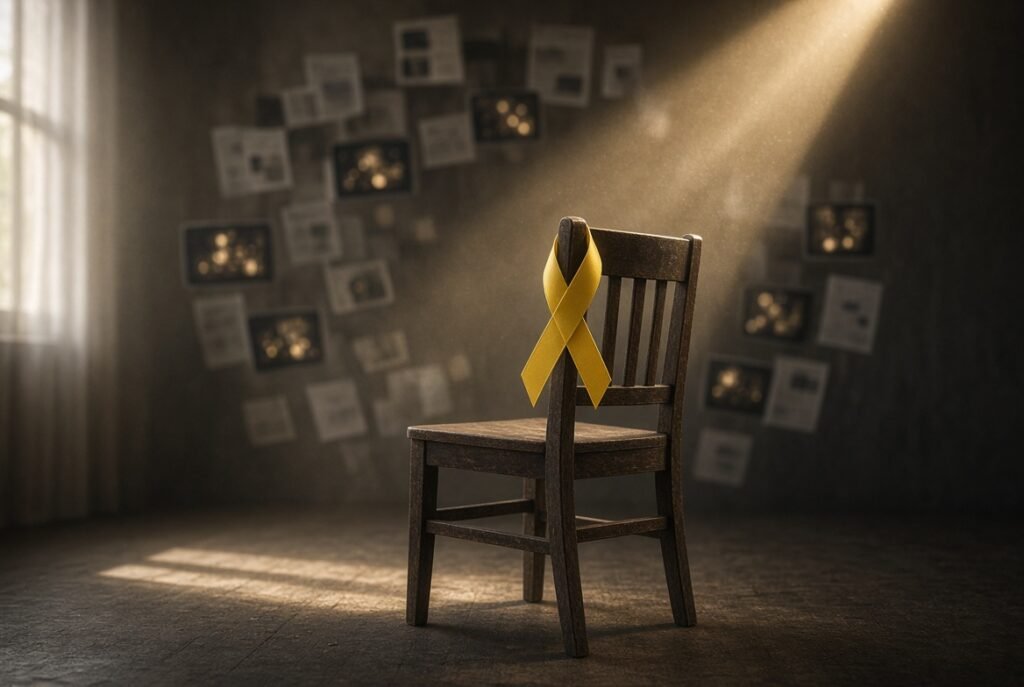
Until that happens, Yellow September runs the risk of looking like what Minority Report also was: an apparatus of good conscience that justifies, in the name of protection, the anticipated destruction of someone. The difference is that, in real life, there is no next scene in which the system denounces itself. There is only an empty chair — and, around it, the same headlines as always.
Note of respect
If you are in suffering, seek help now. In Brazil, the Centro de Valorização da Vida answers 188, 24 hours, in confidence. Speak to someone you trust. You do not have to cross this alone. In the United States, call or text 988.
Sources supporting the argument
Coverage of the Alexander Rogers inquest (BBC, The Telegraph, 2024).
Brazilian reporting on virtual lynching and the case of Jéssica Vitória (O Globo, Brasil de Fato, 2023–2024).
Clinical literature on cancellation in adolescence (Newport Academy).
Yellow September campaign materials (ABP/CFM) and WHO guidelines for responsible coverage.


