


On 14 August 2021, Bruno Oscar Graf, a healthy 28-year-old lawyer, son of Arlene Ferrari Graf, received the first dose of the AstraZeneca vaccine at Parque Vila Germânica, in Blumenau. Twelve days later he was dead. The immediate cause was a haemorrhagic stroke.
The cause the family had to go and find — because the hospital came to suspect dengue and the test that closes the diagnosis was not on the public system — is called thrombosis with thrombocytopenia syndrome, TTS. When the laboratory finds the antibody that defines it, the name is VITT.
Five months before the needle in Bruno’s arm, dozens of European countries had already stopped or restricted that same vaccine because of clots. Brazil did not stop. This text is not a campaign. It records what was already published, what the Brazilian state knew, and what the mother had to pay in order to prove it.
The paper the family authorised for publication
The result below was provided and authorised by the Graf family. It is the anti-heparin PF4 antibody report, enzyme immunoassay (ELISA), citrated plasma. Result: positive. Laboratory reference: negative if optical density is less than or equal to 0.4; positive if greater than 0.4.
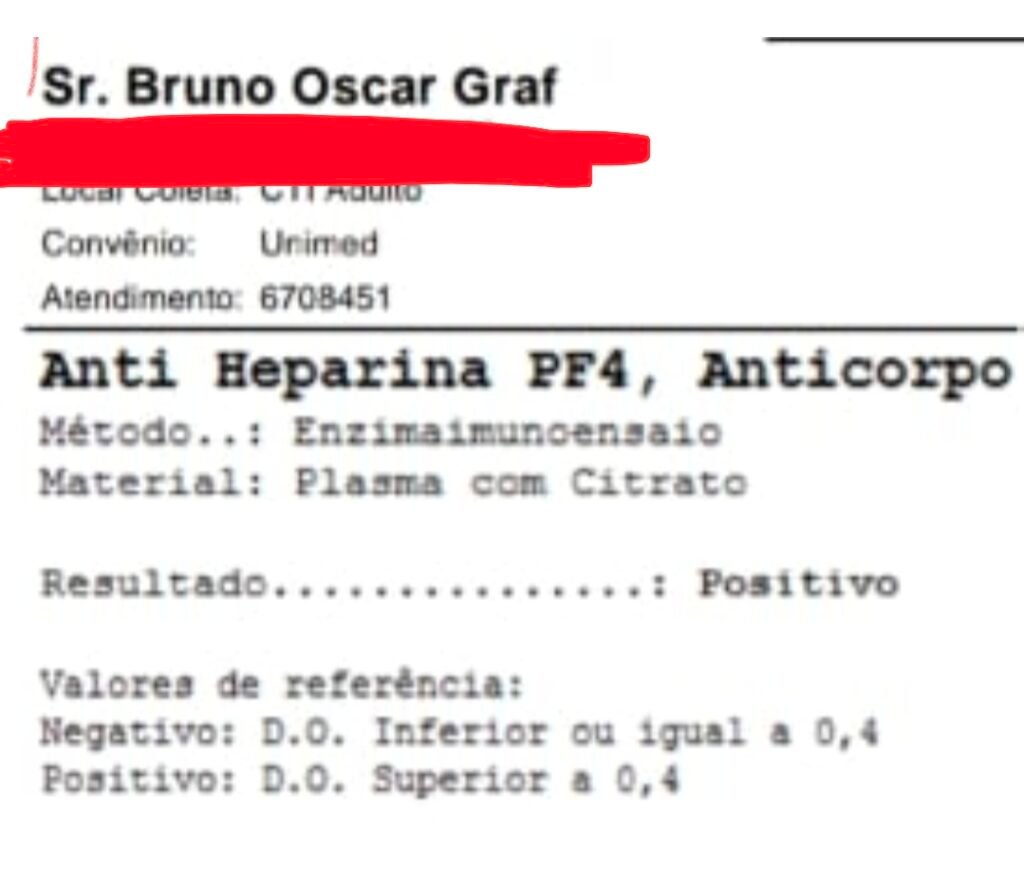
It is not an allergy test. It is the assay that looks for an antibody against platelet factor 4. When that antibody appears after an adenovirus-vector vaccine, it aggregates platelets, consumes platelets and forms thrombi in atypical places — often in the venous sinuses of the brain. The brain bleeds. The headache becomes a haemorrhage.
In plain language: the blood clots where it should not, and there are too few platelets to stop the bleeding. That is why Bruno’s stroke was haemorrhagic. That is why the dengue hypothesis was not enough.
The warning left The Lancet in 2020 — before the campaign
On 19 October 2020, months before any AstraZeneca dose in a Brazilian arm, The Lancet published the letter “Use of adenovirus type-5 vectored vaccines: a cautionary tale.”
The authors are Susan P. Buchbinder, M. Juliana McElrath, Carl Dieffenbach and Lawrence Corey (Lancet, 2020; 396: e68-e69). The text did not yet speak of VITT. It spoke of something else the adenovirus platform had already left in the record: in the Step and Phambili HIV-vaccine trials with an Ad5 vector, vaccinated men had an increased risk of acquiring HIV-1.
The authors wrote that they were concerned about use of the same type of vector against SARS-CoV-2 and asked for a safety evaluation and informed consent that reflected the literature. Title of the piece: a cautionary tale. Date: October 2020.
AstraZeneca uses a chimpanzee adenovirus (ChAdOx1), not the human Ad5 of those HIV vaccines. The letter is still the public record that the adenovirus platform did not arrive at the pandemic as a technology without a past. It arrived with a warning published in the most widely read medical journal in the world.
Europe stopped in March. Brazil administered in August
On 11 March 2021 Denmark suspended AstraZeneca after thrombosis and a death. Norway and Iceland followed. On 15 March, Germany, France and Italy halted the shots. On 30 March Germany restricted the product to people aged 60 or over. The United Kingdom began to prefer another vaccine for those under 30. On 14 April Denmark dropped AstraZeneca for good.
In the same period, Brazil did the opposite.
On 7 April 2021 Anvisa, in Communiqué GGMON 004/2021, asked for a label change, recorded 47 suspected thromboembolism cases in VigiMed — one with thrombocytopenia — and wrote that causality “was not yet established.”
On 8 April Reuters reported that Brazil and Mexico would not limit the vaccine. On 24 June, Communiqué GGMON 006/2021: Anvisa was already using the name TTS and saying that early diagnosis and treatment were essential. It restricted pregnant women. It did not restrict the 28-year-old man.
Bruno received the first dose on 14 August 2021. He was the age Germany, since March, refused for that vaccine. The Ministry of Health only recommended, in Technical Note 393/2022 of 27 December 2022, that those under 40 should preferably receive a platform that was not a viral vector. Gazeta do Povo counted: 600 days after the British restriction on those under 30.
What Goethe University described
On 26 May 2021 Valor Econômico picked up, via the Financial Times, the work of Professor Rolf Marschalek, of the Institute of Pharmaceutical Biology at Goethe University in Frankfurt. The piece ran under the headline that scientists said they had unravelled the cause of clots in COVID-19 vaccines.
Marschalek held that the problem sits in the adenovirus vector of the AstraZeneca/Oxford and Janssen vaccines. That vector takes the spike-protein gene to the cell nucleus, not to the cytosol — the fluid where the coronavirus, an RNA virus, normally makes protein. In the nucleus, the spike sequence — which nature did not optimise to be read there — undergoes splicing: pieces of the gene join or split. Mutant versions of the protein appear, unable to lock onto the cell membrane. Those soluble versions are secreted and, on the group’s hypothesis, trip the cascade that ends in a clot.
Professor Johannes Oldenburg, of the University of Bonn, cautioned in the same coverage that the hypothesis still needed experimental proof linking spike splicing to the adverse reaction. Jonathan Ball, a molecular virologist at the University of Nottingham, told Bloomberg that the data showed production of truncated spike, but did not close the link to coagulation.
Marschalek presented the material to the Paul-Ehrlich-Institut, the German vaccine regulator. Johnson & Johnson, according to Marschalek himself, approached the laboratory to discuss how to redesign the sequence and reduce splicing.
The Frankfurt hypothesis does not replace the immunological mechanism described weeks earlier. In March 2021, Andreas Greinacher, of Universitätsmedizin Greifswald, and Sabine Eichinger, of the Medical University of Vienna, showed in the New England Journal of Medicine that the patients had platelet-activating antibodies against PF4 — the same target as Bruno’s report. Three German laboratories worked the puzzle at the same time: Greifswald (antibody), Ulm and Frankfurt (vector and splicing). Bruno’s ELISA speaks Greinacher’s language. The platform Brazil insisted on giving a 28-year-old is Marschalek’s language.
The Ministry named the test and admitted the public system did not have it
On 20 August 2021 — six days after Bruno’s dose, six days before his death — the National Immunisation Programme published Technical Note 933/2021-CGPNI/DEIDT/SVS/MS.
The note asked for notification in e-SUS Notifica, collection in a citrate tube and shipment to Hemorio, in Rio. It asked for treatment without waiting for the report: intravenous immunoglobulin, an anticoagulant that is not heparin.
Bruno was admitted on the 23rd. On the 24th the brain bled. The positive ELISA did not come out of the public-system queue. It came out of his mother’s pocket. Without the ELISA, the death certificate becomes “haemorrhagic stroke.”
The Mortality Information System records what the doctor wrote. An adverse-event notification can die as a temporal coincidence. With the ELISA, the case enters the definition the Ministry itself copied from the literature.
Santa Catarina’s Directorate of Epidemiological Surveillance recognised the death of the 28-year-old man from Blumenau as central-nervous-system thrombosis with thrombocytopenia associated with AstraZeneca.
In 2022, an article in the journal Vaccine described 39 suspected VITT cases in Brazil, with PNI and Fiocruz data: 36 after AstraZeneca, most after the first dose, median age 41, central nervous system in 21 of 39, mortality 51% — higher with bleeding inside the head (Vaccine, 2022; 40: 4788-4795). The portrait is Bruno’s portrait.
The chance lost in the corridor
The doctrine of loss of a chance does not require proof that Bruno would have survived. It requires proof that a serious chance existed and that it was taken away.
One chance was not to receive that platform at that age. In March Germany already refused AstraZeneca to anyone under 60. In April the United Kingdom was already diverting those under 30. In May Marschalek was already describing the vector in the nucleus. In June Anvisa was already naming TTS. In August Brazil was still putting the first dose in the arm of a 28-year-old lawyer.
Bruno’s picture was: recent vaccine, headache, low platelets: the path in note 933. The correct conduct? Imaging of the dural sinuses, D-dimer, immunoglobulin, no heparin. Once the bleed is established, mortality is high. Before the bleed, time counts.
Another chance is that of memory. Without the report the family authorised for reproduction here, Bruno would be one more stroke in a young man. With the report, there is a name, a date, a method and a result. Positive.
Thank you
Thank you, Bruno Graf, because your case makes it impossible to say that “there was nothing to know.”
There was The Lancet of October 2020 asking for caution with an adenovirus vector. There was the Danish suspension of 11 March 2021. There were Greinacher in Greifswald and Eichinger in Vienna describing anti-PF4. There was Marschalek in Frankfurt describing splicing in the nucleus. There was Anvisa in June talking about early diagnosis. There was Note 933 admitting that the ELISA was not on the public system.
What there was not was the age restriction Europe had already made. What there was not was the test on the shelf of the hospital in Blumenau. What there was not was consent that said, in plain Portuguese, the name of the syndrome.
Arlene Ferrari Graf authorised use of the image and authorised the text as it stands. If she changes her mind and wants to speak, the space is hers — not to explain her son’s death again, but to ask why a 28-year-old man received in August the vaccine that Germany, since March, refused to anyone under 60.
Isabel de Fátima Alvim Braga — physician and lawyer. This article records published papers, official notes and a family-authorised laboratory report. It is not a campaign text.
References
1. Buchbinder SP, McElrath MJ, Dieffenbach C, Corey L. Use of adenovirus type-5 vectored vaccines: a cautionary tale. Lancet. 2020;396:e68-e69. DOI: 10.1016/S0140-6736(20)32156-5. 19 October 2020.
2. Greinacher A et al. Thrombotic thrombocytopenia after ChAdOx1 nCov-19 vaccination. N Engl J Med. 2021;384:2092-2101.
3. Schultz NH et al. Thrombosis and thrombocytopenia after ChAdOx1 nCoV-19 vaccination. N Engl J Med. 2021;384:2124-2130.
4. Marschalek R et al. Goethe University Frankfurt. Spike-splicing hypothesis after adenoviral-vector vaccines. Coverage: Financial Times, 26 May 2021; Valor Econômico, same date.
5. Oldenburg J. Comment on Marschalek. University of Bonn. Valor Econômico / Financial Times, 26 May 2021.
6. Anvisa. Communiqué GGMON 004/2021. Oxford/AstraZeneca/Fiocruz label change. 7 April 2021.
7. Anvisa. Communiqué GGMON 006/2021. Alert on TTS associated with adenovirus vaccines. 24 June 2021.
8. Ministry of Health. Technical Note 441/2021-CGPNI/DEIDT/SVS/MS. Investigation and management of TTS.
9. Ministry of Health. Technical Note 933/2021. 20 August 2021. Anti-PF4 ELISA as gold standard; unavailability in the public system.
10. Ministry of Health. Technical Note 393/2022. 27 December 2022. Preference for a non-viral platform under 40.
11. Reuters. Mexico, Brazil will not limit AstraZeneca vaccine after UK blood clot warning. 7–8 April 2021.
12. Associated Press / BBC. Germany restricts AstraZeneca to those over 60. 30–31 March 2021.
13. G1. Temporary suspension of the Oxford vaccine in some European countries. 11–16 March 2021.
14. Santa Catarina Directorate of Epidemiological Surveillance. Bulletin recognising Bruno Oscar Graf’s death as TTS associated with AstraZeneca. 2021.
15. Bio-Manguinhos/Fiocruz and PNI/MS. Vaccine-induced immune thrombotic thrombocytopenia after COVID-19 vaccination: 39 cases in Brazil. Vaccine. 2022;40:4788-4795.
16. Gazeta do Povo. AstraZeneca: Brazil followed the British contraindication 600 days later. 16 April 2023.

 Português do Brasil